
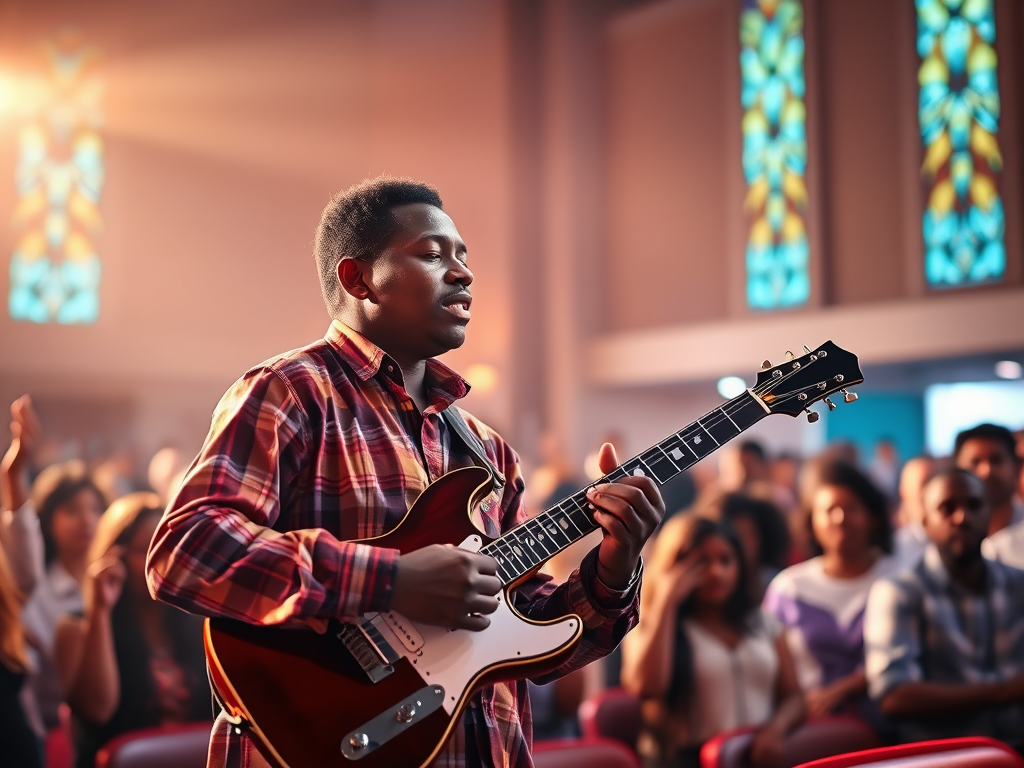
Improvisation is a powerful tool for gospel guitarists—but in a worship setting, how you play matters just as much as what you play. Gospel guitar leads aren’t about showing chops or filling every space. They’re about supporting the moment, honoring the song, and enhancing the message without distracting from it.
Tasteful improvisation is one of the biggest differences between a guitarist who plays notes and a guitarist who serves worship.
The Role of a Lead Guitarist in Worship
In gospel music, the lead guitarist’s role shifts constantly. One moment you’re reinforcing harmony, the next you’re answering the singer, and sometimes the most spiritual thing you can do is stay silent.
A tasteful gospel lead supports the vocal and lyrical message, responds to what the band and choir are doing, enhances emotion without overpowering the moment, and leaves space for prayer, exhortation, and dynamics.
Your lead lines should feel like conversation, not interruption.
Start With the Chords, Not the Scale
One of the biggest mistakes gospel guitarists make when improvising is thinking in scales first. Tasteful leads almost always come from the chords underneath.
Instead of asking, “What scale fits here?” ask what chord is being played, which chord tones you can highlight, and how you can move smoothly into the next chord.
Targeting chord tones—especially the 3rd and 7th—will instantly make your lines sound intentional and connected to the music.
Use Space as Part of Your Vocabulary
Space is not empty—it’s expressive.
In worship settings, leaving room between phrases allows the lyrics to breathe, the congregation to respond, and the band to stay locked together.
Try playing a short phrase, stopping completely, letting the moment speak, and responding only when the music calls for it. If your lead sounds good without constant motion, you’re on the right track.
Think Call and Response, Not Continuous Soloing
Gospel music is rooted in call and response. Your lead lines should often answer the singer, not compete with them.
This might look like a short lick after a vocal phrase, a gentle response to a preacher’s cadence, or a simple melodic echo of the choir line. This approach keeps your playing musical, conversational, and respectful of the worship flow.
Control Your Dynamics and Touch
Tasteful improvisation depends heavily on how hard you play, not just which notes you choose.
Focus on picking lighter during prayerful moments, digging in only when the music builds, and letting emotion guide intensity instead of habit. Often, the same lick played softer will minister more than a louder, flashier phrase.
Limit Your Note Choices on Purpose
Less is more—especially in worship.
Instead of running up and down the neck, limit yourself to three to five notes per phrase, stay in one position for an entire section, and repeat motifs with slight variations. These self-imposed limits force you to play with intention rather than muscle memory.
Know When Not to Play
One of the most mature gospel guitar skills is knowing when to step back completely.
You may not need to play when the pastor is speaking, the singer is delivering a key lyric, the band is intentionally pulling dynamics down, or the moment calls for silence. Restraint is not weakness—it’s wisdom.
Practice Improvisation the Worship Way
To grow in tasteful gospel lead playing, practice with context, not just technique.
Loop a simple gospel progression, practice responding instead of soloing, play only between imaginary vocal lines, and record yourself to listen for overplaying. The goal isn’t to impress—it’s to blend, support, and uplift.
Final Thoughts
Gospel guitar leads are about ministry, not spotlight. When improvisation is guided by listening, restraint, and intention, your playing becomes a tool that serves worship instead of distracting from it.
Play what the moment needs.
Leave space when the Spirit is moving.
And remember—sometimes the tastiest lead is knowing when to stay quiet.
Learn More and Go Deeper
If you want to see these concepts demonstrated on guitar, I share practical gospel guitar lessons, chord breakdowns, and real-world church playing examples on my YouTube channel:
👉 https://www.youtube.com/user/juligan01
For those who want to go deeper, my Patreon community offers exclusive lessons, extended breakdowns, practice materials, and behind-the-scenes teaching designed specifically for gospel guitar players:
👉 https://www.patreon.com/cw/JulianHoover
Your support helps keep this teaching focused, consistent, and rooted in serving musicians who want to grow while honoring the music and the moment.
Leave a Reply