
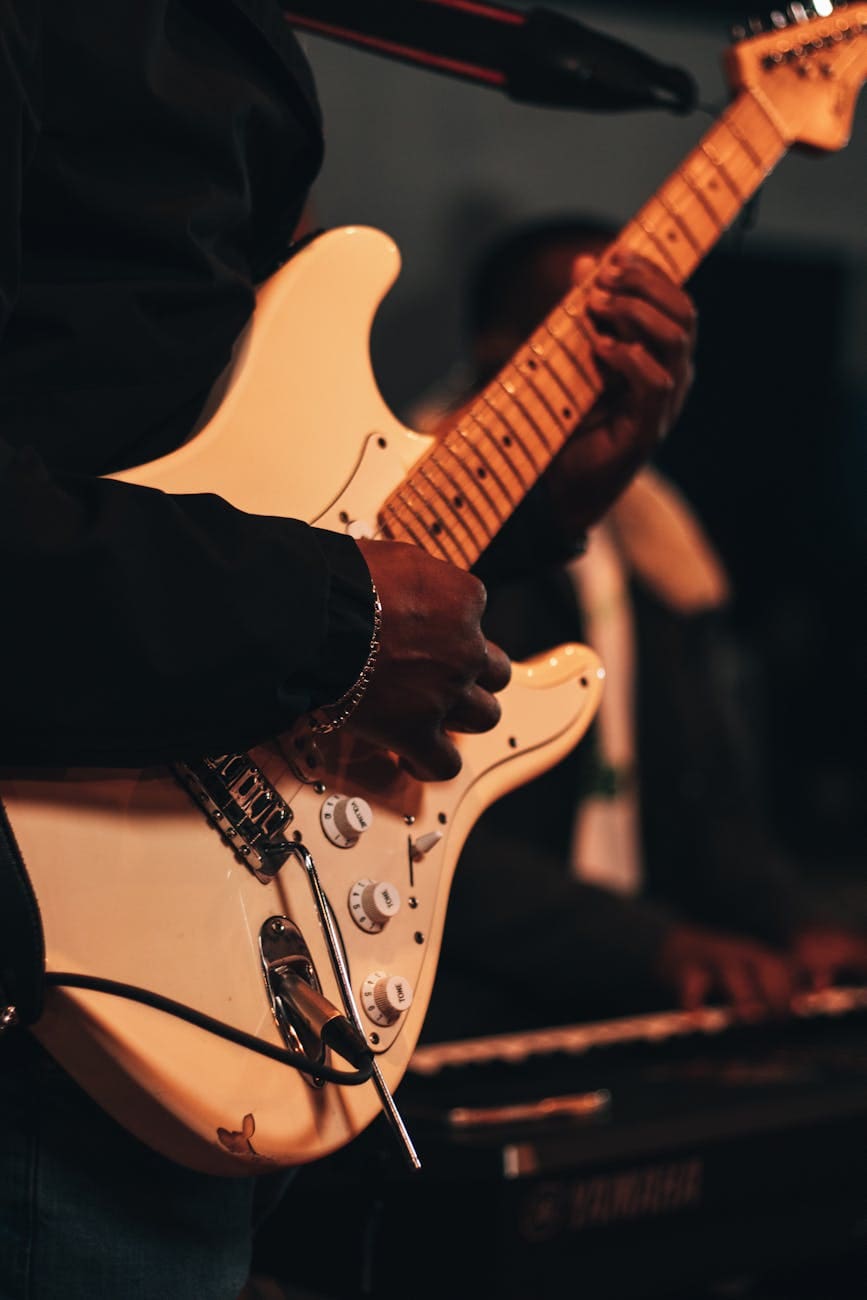
Quick answer: Learn gospel guitar in this order: core chord types, chord inversions, the five most common progressions, passing chords, rhythm placement and worship feel, song application, and ear training. Skip advanced licks, complex theory, and fast runs at the beginning. Progress comes from following the right sequence, not from collecting more information.
Learning gospel guitar can feel overwhelming when you are just starting out. There are so many things players tell you to study: chords, scales, licks, passing chords, inversions, praise breaks, riffs, worship pads, and ear training.
Most beginners try to learn everything at once and end up progressing very slowly. Gospel guitar becomes much easier when you learn the right things in the right order. This roadmap shows you exactly what to focus on first.
Why Do Most Beginner Gospel Guitar Players Stay Stuck?
Most players do one of two things.
Mistake 1: They Only Learn Songs
Songs help, but songs without understanding create dependency. You can copy a progression and still not understand why the chords work. When the next song comes along, you start from zero again.
Mistake 2: They Only Learn Random Chord Names
Memorizing chord grips without movement patterns does not create gospel musicianship. A long list of shapes is of little use if you do not know when to play them or how to get from one to the next.
Real growth happens when chord knowledge, movement knowledge, and church feel develop together. That is what this roadmap is built around. Each stage prepares you for the one after it, so nothing you learn is wasted.
Many of the voicing systems, chord families, and progression concepts in this roadmap are taught in my book Gospel Guitar Chord Voicings, a practical method guide for players who want to build a real gospel foundation.
Stage 1: Which Core Gospel Chord Types Should You Learn First?
Before anything flashy, you need chord vocabulary. Start with these:
- Major triads
- Minor triads
- Dominant 7 chords
- Major 7 chords
- Minor 7 chords
- Suspended chords
- Diminished chords
- Add9 and 6/9 worship colors
Do not just learn one shape of each. Learn simple movable shapes, especially on the top four strings. This immediately begins moving you toward authentic church comping instead of open-chord strumming.
Your first goal is simple: be able to recognize the emotional sound of each chord family. Major 7 is warm. Dominant 7 is restless. Minor 7 is soft and reflective. Hearing those differences matters as much as fingering the shapes. 15 Easy Gospel Chords That Make Your Playing Sound Professional describes each of these chords.
Spend two to four weeks here. Play each chord type in three or four keys, and check that every note rings clearly.
Stage 2: Why Learn Chord Inversions?
This is where gospel guitar starts sounding smooth. Most beginners play every chord in root position, with the root as the lowest note. That causes clunky movement, awkward jumps, and basic-sounding transitions.
Inversions rearrange the notes of a chord so that a different note is on the bottom. Every triad has three inversions, and each sits in a different place on the neck.
Inversions allow nearby movement: small shifts, shared tones, and professional-sounding voice leading. Instead of leaping five frets to the next chord, you move one or two fingers. Even basic triad inversions can make a beginner sound dramatically more advanced.
Start with major and minor triads on the top three strings. Learn all three inversions of C, F, and G, then play a 1-4-5 progression three different ways without moving more than a few frets. How to Voice Gospel Triads on Guitar Clearly covers this skill.
Stage 3: What Are the Five Most Common Gospel Progressions?
Once chord families are familiar, you need movement. Focus on mastering these:
- The 1 to 4 worship progression
- The 2-5-1 cadence
- The 1-6-2-5 turnaround
- The gospel shout vamp
- Chromatic walk-up and walk-down movement
These progressions appear constantly in praise songs, choir songs, preacher moments, worship ballads, and traditional hymns.
Learn each one as numbers, and practice it in several keys. At this stage you begin hearing repetition across many songs. That is when gospel starts making musical sense, because you realize that hundreds of songs are built from the same few patterns. Common Gospel Guitar Progressions and Common 2-5-1 Patterns in Gospel Guitar explain these in detail.
Give this stage a month. It is the core of the roadmap.
What Is the Fastest Way to Learn These Chords in Order?
Trying to piece this together from random videos can take years. That is why I wrote Gospel Guitar Chord Voicings: to give beginners and intermediate players a structured path through the upper-string chord shapes, inversions, and gospel movements used in real church playing.
A structured resource tells you what to practice next and shows you how each new shape relates to the ones you already know.
Stage 4: How Do Passing Chords and Connecting Harmony Fit In?
This is where the “church sound” really begins to appear. Passing chords are the little in-between movements that make progressions feel alive. Examples include:
- Diminished connectors
- Half-step approach chords
- Dominant push chords
- Bass walk harmonization
Without these, a player sounds functional. With these, a player sounds gospel. This is usually the point where listeners begin saying, “Okay, now that sounds like church.”
Add them one at a time. Begin with a dominant 7 chord on the beat before a move to the 4 chord. Then learn a diminished chord a half step below the 2 chord. Place each passing chord on the last beat before a change, and keep it short. How to Add Passing Chords on Guitar (Gospel Style) gives you clear examples.
Stage 5: How Do You Learn Rhythm Placement and Worship Feel?
Gospel guitar is not just chord selection. It is chord timing. You must learn:
- When to stab chords
- When to sustain chords
- When to leave silence
- When to answer the singer
- When to build intensity
A beginner with average chords but good feel can sound better than an advanced player with no pocket. This stage requires listening and playing along with recordings regularly.
Practice short, muted chops on beats two and four with a metronome. Practice holding one chord per bar. Practice resting for whole sections. Rhythm work should be part of every practice session from the beginning, even while you work on the earlier stages. Playing Gospel with Feel: Rhythm, Space, and Time and Muting Techniques Every Gospel Guitarist Should Know will guide you.
Stage 6: How Do You Apply Everything to Songs?
Now bring the pieces together in real music. Choose a few songs your church sings and learn them using what you have built.
For each song, work out the progression in numbers. Choose voicings from your chord vocabulary. Use inversions to keep the changes smooth. Add one or two passing chords. Decide on your rhythm for each section.
Start with simple songs and work toward richer ones. Play along with recordings, and if you can, play with other musicians. Application is where knowledge becomes skill. It also shows you which earlier stages need more work. Top 10 Gospel Songs for Guitar Every Church Musician Should Know suggests songs to learn.
Stage 7: How Do You Train Your Ear to Hear Gospel Movement?
Ear training runs alongside everything else, but it deserves its own focus once you can play the common progressions.
Listen for the bass line in recordings and find the root movement. Try to name progressions as you hear them: that is a 2-5-1, that is a turnaround, that is a walk-up to the 4. Sing the roots of the chords as you play.
In church, a strong ear is what lets you follow songs you have never rehearsed and catch the passing chords a keyboard player adds. It is the skill that makes a guitarist independent of charts. Develop Your Musical Ear for Gospel Chord Changes lays out a step-by-step approach.
What Should You Ignore at the Beginning?
Knowing what to leave for later is as important as knowing what to study. In your first months, set aside:
- Fast licks and shred runs
- Complex altered chords and substitutions
- Advanced scale and mode theory
- Expensive gear and large pedalboards
- Trying to copy advanced players note for note
These are not bad. They are simply not what a beginner needs. Time spent on them is time taken from chords, movement, and feel, which are the things that will get you playing in church.
You will come back to many of these later, and they will make far more sense once the foundation is in place.
How Long Does Each Stage Take?
Everyone moves at a different pace, but a rough guide helps. With 20 to 30 minutes of daily practice:
- Stages 1 and 2: about one to two months
- Stage 3: about one month
- Stage 4: about one month
- Stage 5: ongoing from the start
- Stages 6 and 7: ongoing once the first four are underway
Within four to six months, most committed beginners can play common progressions with smooth voicings and a few passing chords in several keys.
Do not rush. Moving to the next stage before the current one is secure only slows you down later. How to Practice Gospel Guitar at Home shows how to structure daily sessions.
Why Is the Goal the Right Sequence and Not More Information?
There has never been more gospel guitar information available. Videos, charts, and lessons are everywhere. The problem most players face is not a lack of material. It is not knowing what order to study it in.
Information without sequence produces confusion. You learn an advanced passing chord before you can play the progression it belongs to, and it never sticks.
Sequence produces momentum. Each skill supports the next, and you can feel yourself improving. Follow the stages in order, give each one enough time, and resist the pull of whatever looks exciting this week.
Frequently Asked Questions
What should a beginner learn first on gospel guitar?
Core chord types, including major, minor, dominant 7, major 7, and minor 7, played as small movable shapes.
When should I start learning passing chords?
After you can play the common progressions smoothly in a few keys using inversions.
Do I need to learn scales first?
No. Chords, progressions, and rhythm come first. Scales become useful later for fills and lead lines.
How much should I practice each day?
Twenty to thirty focused minutes a day is enough to make steady progress.
Follow the roadmap one stage at a time, and you will build authentic church guitar skills without feeling scattered.
Leave a Reply