
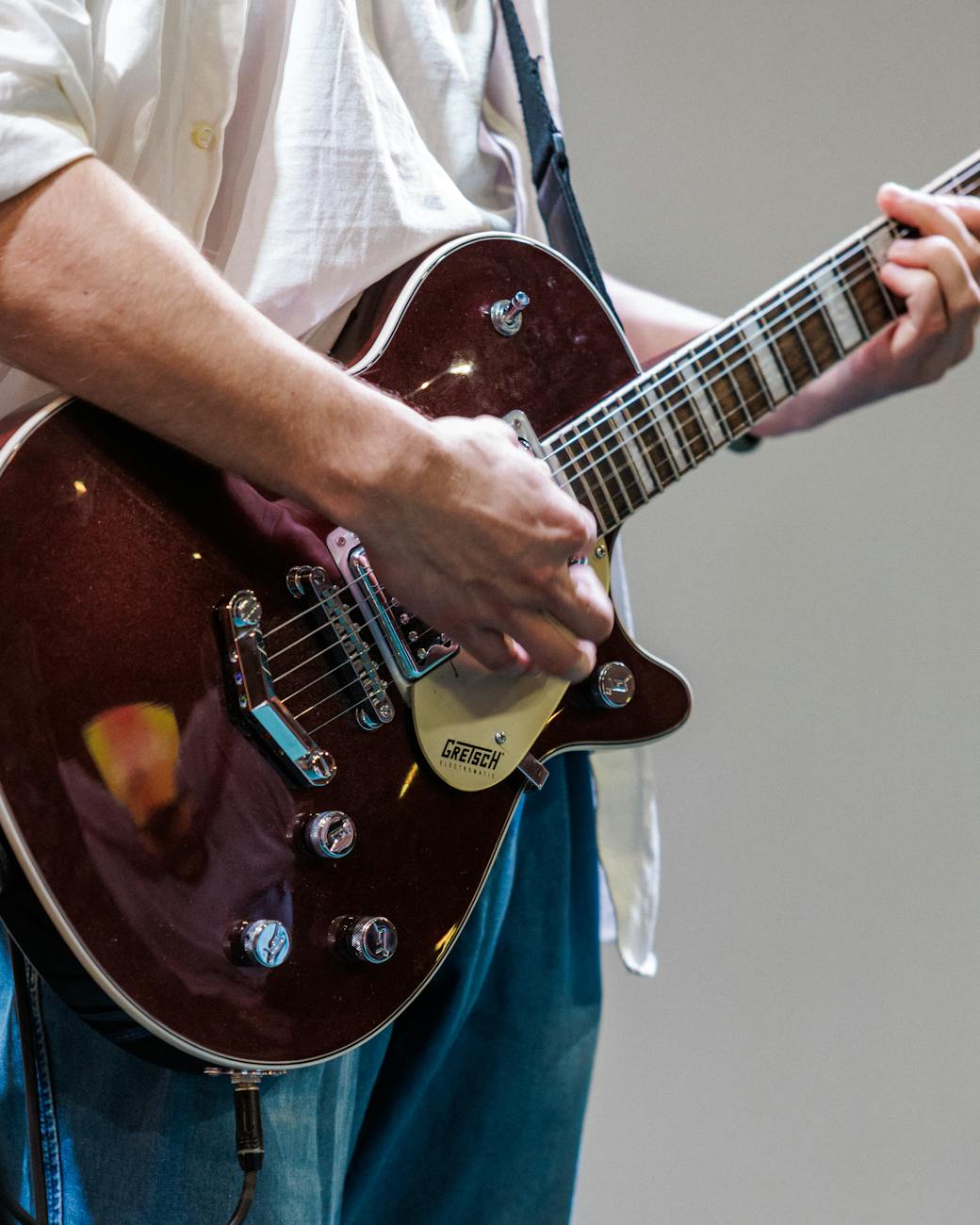
Quick answer: Dominant 7 CAGED chords are five movable shapes based on the open chords E7, D7, C7, A7, and G7. A dominant 7 chord contains the root, major 3rd, perfect 5th, and minor 7th, and it creates tension that resolves to the next chord. Learning all five shapes lets you play blues, gospel, and jazz harmony in any key and any position on the neck.
If you want to sound more expressive, soulful, and harmonically advanced on guitar, learning dominant 7 CAGED chords is essential.
Dominant chords drive the harmony in blues, gospel, and jazz. The CAGED system gives you a simple way to locate them anywhere on the fretboard.
👉 Get your copy of CAGED System Guitar Chords here
What Are Dominant 7 CAGED Chords?
The CAGED system arranges the fretboard into five connected chord forms: C, A, G, E, and D.
Each form has a dominant 7 version. Together, the five dominant shapes let you play any dominant 7 chord in five different places.
The benefit is more than a larger stock of shapes. You come to see how the positions link up, which makes it far easier to move smoothly from one chord to the next. CAGED System for Guitar: Major, Minor, Dominant, and More describes the whole framework.
👉 Get your copy of CAGED System Guitar Chords here
What Is a Dominant 7 Chord?
A dominant 7 chord contains four notes:
- Root
- Major 3rd
- Perfect 5th
- Minor 7th
For example, G7 is G, B, D, and F.
It differs from a major 7 chord by one note. The seventh is a whole step below the root, not a half step. The major 3rd and the minor 7th are three whole steps apart, an interval called a tritone. That interval gives the chord its restless, unresolved sound.
👉 Start mastering the fretboard today
Why Are Dominant 7 Chords So Important?
The dominant 7 occurs naturally on the 5 chord of a major key. In the key of C, that chord is G7.
Its tension pulls strongly toward the 1 chord. This movement from 5 to 1 is the most important resolution in Western harmony, and it appears in nearly every style.
In blues, dominant 7 chords are used on the 1, 4, and 5 alike, which produces the characteristic blues sound. In gospel and jazz, extra dominant chords are placed before other chords to lead into them. These are called secondary dominants, and they account for much of the forward motion in those styles.
👉 Start mastering the fretboard today
Why Learn the Entire CAGED Chord Vocabulary?
Many lessons offer one or two dominant shapes. Players who want real freedom need major, minor, dominant, and half-diminished systems, together with inversions, voice leading, and fretboard visualization.
CAGED System Guitar Chords is a method book built around that full vocabulary. It teaches connected chord forms across the neck, chord construction and theory, smooth harmonic movement, and practical applications with musical exercises.
It is aimed at players of blues, gospel, jazz, worship, and neo-soul who want to understand the fretboard and not only memorize it. The book was written by Julian Hoover, the author of this site.
👉 Learn more about CAGED System Guitar Chords
What Are the Five Dominant 7 CAGED Shapes?
Each form begins as an open dominant 7 chord. With a barre or a partial fingering, it can be moved to any fret. The sections below describe each one.
👉 Watch guitar lessons on YouTube
1. What Is the E7 Shape?
The E7 form has its root on the low E string. It is the six-string major barre chord with one finger lifted, which uncovers the minor 7th on the D string.
Examples include G7 at the 3rd fret, A7 at the 5th fret, and B7 at the 7th fret.
👉 Learn more about CAGED System Guitar Chords
This is a strong, full voicing for blues rhythm, gospel shouts, and funk. It is also one of the easiest dominant shapes to find quickly.
2. What Is the D7 Shape?
The D7 form has its root on the D string and sits on the top four strings.
It gives a bright, compact sound that works well for upper-register comping, chord melody, and short fills. E7 at the 2nd fret and G7 at the 5th fret are examples.
👉 Get your copy of CAGED System Guitar Chords here
Its small size makes it easy to slide into from a fret below, a common device in blues and gospel.
3. What Is the C7 Shape?
The C7 form has its root on the A string, with the chord lying behind it toward the nut.
It is a favorite in blues, country, and jazz for its warm, close sound. D7 with the root at the 5th fret and E7 with the root at the 7th fret are common uses.
The shape also converts easily into a ninth chord, which is a staple of funk and gospel rhythm guitar.
👉 Get your copy of CAGED System Guitar Chords here
4. What Is the A7 Shape?
The A7 form has its root on the A string. It is the five-string major barre chord with the minor 7th exposed on the G string.
Examples include C7 at the 3rd fret, D7 at the 5th fret, and E7 at the 7th fret.
Combined with the E7 shape, it lets you play a complete blues in one area of the neck, since the 1, 4, and 5 chords all lie within a few frets.
👉 Learn more about CAGED System Guitar Chords
5. What Is the G7 Shape?
The G7 form has its root on the low E string, under the fourth finger. The full chord is a wide stretch and is seldom played complete.
Players usually take the top three or four strings as a fragment. The shape matters chiefly because it links the A7 form to the E7 form along the neck.
👉 Get charts and practice materials on Patreon
How Do the Five Dominant Shapes Connect?
Along the neck, the shapes follow the order C, A, G, E, D, and each one overlaps the next.
Take C7. The open chord is the C shape. The A shape is at the 3rd fret, the G shape lies around the 5th to 8th frets, the E shape is at the 8th fret, and the D shape is around the 10th fret. The cycle begins again at the 12th fret.
Play them in order to hear one chord in five registers.
👉 Start mastering the fretboard today
How Do Advanced Guitarists Use Dominant 7 Chords?
Experienced players break the shapes into smaller parts and add color. Common uses include:
- Shell voicings with the root, 3rd, and 7th
- Tritone fragments using only the 3rd and 7th
- Ninth and thirteenth chords
- Altered dominants, with a sharp or flat 9
- Secondary dominants leading into other chords
- Passing chords approached from a half step above or below
The two-note tritone fragment deserves special mention. Since the 3rd and 7th define the chord, those two notes alone can suggest the whole harmony when a bass player supplies the root.
👉 See these ideas demonstrated on YouTube
Why Learn Dominant 7 Chords Across the Entire Neck?
Blues, gospel, and jazz progressions change chords often. If every change requires a large jump, the playing sounds disjointed.
👉 Start mastering the fretboard today
With all five shapes available, the next chord is always close. You can also choose a higher or lower voicing to suit the arrangement.
Knowing where the 3rd and 7th lie in each shape helps with soloing as well. Those are the notes that make a line sound connected to the chord. CAGED System for Jazz Guitar applies this to chord movement.
What Is the Best Way to Practice Dominant 7 CAGED Chords?
Four habits produce steady results.
Practice One Key Everywhere
Choose one chord, such as A7 or G7, and find it in all five shapes.
Connect Shapes Horizontally
Move from each shape to its neighbor, and notice the shared notes.
Practice Blues and Jazz Progressions
Play a twelve-bar blues using dominant 7 chords for the 1, 4, and 5. Then play a ii–V–I, such as Dm7 to G7 to Cmaj7, in two positions.
Focus on Voice Leading
Watch how the 7th of one chord moves by a half step to the 3rd of the next. Following that movement keeps your changes smooth.
👉 Learn more about CAGED System Guitar Chords
What Does a Short Daily Routine Look Like?
Ten minutes is enough for real progress.
Spend three minutes playing one dominant 7 chord through all five shapes. Spend four minutes on a twelve-bar blues in one key, staying within a five-fret area. Finish with a ii–V–I in a different key.
Change keys each day. m7 CAGED System for Guitar and Maj7 CAGED System for Guitar cover the other chords in the ii–V–I.
👉 Start mastering the fretboard today
What Mistakes Should You Avoid?
Some errors recur among players learning these chords.
The first is mixing up dominant 7 and major 7. Check the seventh: it should be two frets below the root. The second is using a dominant 7 on every major chord. In most styles outside the blues, it belongs on the 5 chord or on a chord that is leading somewhere.
The third is playing too many strings. A three-note voicing is often stronger and clearer. Common Problems Guitar Players Have With the CAGED System addresses further difficulties.
👉 Learn more about CAGED System Guitar Chords
Frequently Asked Questions
What are dominant 7 CAGED chords?
They are five movable dominant 7 shapes based on the open E7, D7, C7, A7, and G7 chords.
What notes are in a dominant 7 chord?
The root, major 3rd, perfect 5th, and minor 7th.
Where does the dominant 7 chord occur in a key?
On the 5 chord of a major key. In blues, it is also used on the 1 and 4.
Which shapes should I learn first?
Begin with the E7 and A7 shapes, then add the C7 and D7 shapes.
What book teaches dominant chords through the CAGED system?
CAGED System Guitar Chords covers dominant chord structures along with the other chord families.
Leave a Reply