
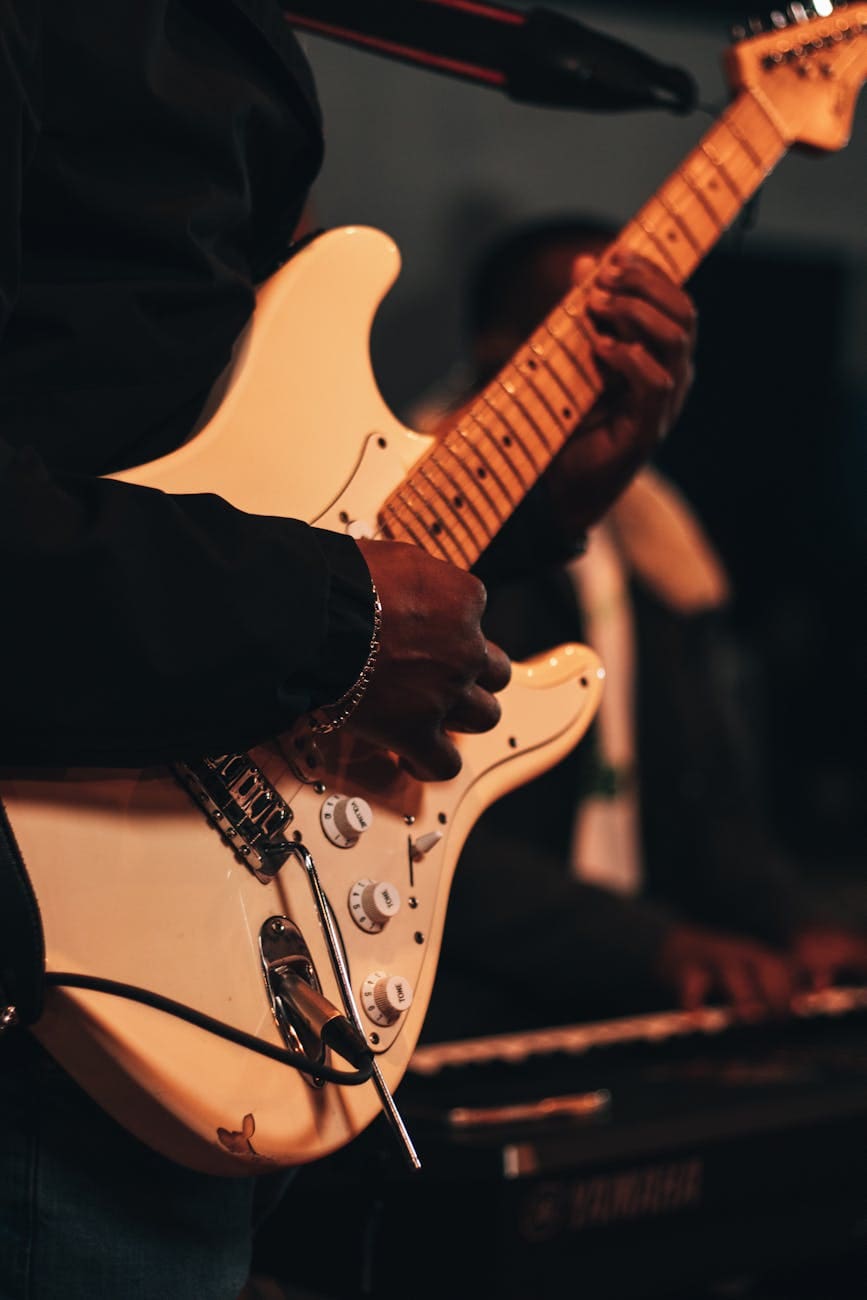
Quick answer: You can start playing gospel guitar in 30 days with 20 to 30 minutes of daily practice and no music reading. Week one covers basic chords and strumming. Week two adds seventh chords and common progressions. Week three works on barre chords, walk-ups, and smooth transitions. Week four covers upper-register voicings, multiple keys, dynamics, and a full song.
If you have ever sat in church and watched the guitarist lock into a groove, walk up to a chord change, and fill the room with that unmistakable gospel sound — and thought, “I want to do that” — this guide is for you.
Starting gospel guitar can feel overwhelming. There is so much to learn: chords, rhythms, theory, technique, song repertoire, playing with a band. Most beginners either dive into random YouTube videos and stall out, or try to learn everything at once and burn out.
This 30-day plan cuts through all of that. It gives you a clear, week-by-week path from absolute beginner to playing your first real gospel progressions — with enough understanding to keep growing long after day 30.
You do not need to read music. You do not need years of classical training. You need a guitar, 20 to 30 minutes a day, and a plan that actually works.
👉 Watch guitar lessons on YouTube
What Should You Expect From This 30-Day Plan?
This plan is built around four weekly phases:
- Week 1: Guitar basics and your first chords
- Week 2: Gospel chord vocabulary and rhythm
- Week 3: Chord movement, transitions, and your first progressions
- Week 4: Gospel technique, voicings, and putting it all together
Each week builds on the last. By day 30, you will be playing recognizable gospel chord progressions, moving between chords smoothly, and beginning to understand the harmonic language that makes gospel guitar sound the way it does.
👉 Get charts and practice materials on Patreon
What Do You Need Before Day 1?
Before you start, make sure you have the basics in place.
A guitar. Any acoustic or electric guitar will work for this plan. Gospel guitar spans both — acoustic for a warmer, hymn-like sound, electric for the full church band experience. If you do not own one yet, a mid-range acoustic in the $150–$300 range is a solid starting point.
A tuner. Never practice out of tune. A clip-on tuner costs less than $15 and is one of the best investments you will make as a beginner. The free GuitarTuna app also works well.
A pick. Medium gauge picks give you the most versatility for gospel strumming and chord work.
A quiet, consistent practice space. Twenty focused minutes beats two unfocused hours every time. Find a spot where you can sit, focus, and play without interruption.
A resource that actually teaches gospel harmony. Most beginner guitar books teach open chords and campfire songs. Gospel guitar requires a different vocabulary — 7th chords, upper voicings, smooth transitions, and an understanding of how harmony moves in a gospel context. If you want a structured guide that covers exactly this, Gospel Guitar Chord Voicings by Julian Hoover is written specifically for guitarists who want to play in a church or gospel setting, with real song applications and voicings that sound authentic from day one.
👉 See these ideas demonstrated on YouTube
Week 1 (Days 1–7): Building Your Foundation
The first week is about getting your hands used to the guitar and learning the basic chord shapes you will need for gospel music.
Day 1–2: Tune Up and Learn Your First Three Chords
Start with three chords that appear constantly in gospel music: G major, D major, and E minor. These three chords alone let you play in the key of G — one of the most common keys in traditional gospel.
Practice each chord individually. Place your fingers, strum slowly, and listen to make sure every string rings cleanly. If a string buzzes, adjust your finger position so it presses closer to the fret.
Spend 10 minutes on each chord, then try switching between G and D slowly.
Day 3–4: Add A Major and E Major
Now add A major and E major to your vocabulary. With these five chords — G, D, Em, A, E — you have the building blocks to play in multiple gospel-friendly keys.
Practice switching between all five chords in any order. Do not rush. Clean, slow changes are far more valuable than fast, sloppy ones.
Day 5–6: Learn Your First Strumming Pattern
Gospel guitar is as much about rhythm as it is about chords. Learn a simple four-beat downstroke pattern first: down on beats 1, 2, 3, and 4. Once that feels steady, add an upstroke on the “and” of beat 2 and beat 4.
This basic pattern — down, down-up, down, down-up — is the foundation of hundreds of gospel and worship songs.
Day 7: Review and Consolidate
Do not learn anything new today. Play through everything you have learned this week slowly and cleanly. The goal is to let your muscle memory catch up with what your brain has been working on. What Is Gospel Guitar? explains the style you are working toward.
👉 Join Patreon for lessons and charts
Week 2 (Days 8–14): Gospel Chord Vocabulary
This is where gospel guitar starts to sound like gospel guitar. This week you move beyond basic open chords into the chord types that define the genre.
Day 8–9: Seventh Chords
Open major and minor chords sound fine, but gospel music lives in seventh chords. The dominant 7th (like G7, D7, A7) adds tension and resolution that drives gospel harmony forward. The major 7th (Gmaj7, Dmaj7) adds warmth. The minor 7th (Em7, Am7) adds depth and color.
Start with dominant 7th chords. Learn G7, D7, and A7. Practice switching between them and their plain major versions to hear how the 7th changes the feel.
Day 10–11: The 2–5–1 Progression
The 2–5–1 progression is the backbone of gospel and jazz harmony. In the key of G, that is Am7 – D7 – Gmaj7. Practice this progression slowly, letting each chord ring, and focus on how naturally the D7 wants to resolve to Gmaj7.
This one progression will unlock hundreds of gospel songs. Once you feel it in G, try it in the key of C: Dm7 – G7 – Cmaj7.
Day 12–13: The 4–1–5–6 Progression
This is the other essential gospel progression — the same one that drives songs like “Way Maker,” “Goodness of God,” and dozens of other worship staples. In the key of G: C – G – D – Em.
Practice moving through this progression with your strumming pattern from Week 1. Focus on clean, even transitions.
Day 14: Apply It to a Real Song
Pick one gospel or worship song you know well and try to find the chords by ear or look up a chord chart online. Apply what you have learned this week to play through it, even slowly. Connecting your practice to real music is what keeps you motivated. See Common Gospel Guitar Progressions.
👉 Watch more guitar lessons on YouTube
Week 3 (Days 15–21): Smooth Transitions and Chord Movement
Knowing chords is one thing. Moving between them musically is another. This week focuses on the transitions and techniques that make gospel guitar playing feel fluid and professional.
Day 15–16: Barre Chords
Barre chords let you play any chord shape anywhere on the neck. They are essential for gospel guitar because they allow you to transpose progressions into any key instantly.
Start with the E-shape barre chord. Place your index finger across all six strings at the 2nd fret, then form an E major chord shape with your remaining fingers. That gives you F# major. Move it to the 5th fret for A major. Same shape, new key.
Barre chords are physically demanding at first. Your hand will get tired. That is normal. Practice for a few minutes, rest, and repeat. Strength builds quickly.
Day 17–18: Voice Leading and Smooth Movement
Gospel guitar is famous for smooth, connected chord movement — where one chord seems to flow into the next without any jarring jumps. This is called voice leading.
The key is to minimize how much your fingers have to move between chords. Look for common tones — notes that stay the same between two chords — and anchor your fingers on those while moving the others.
For a deeper look at how this works in a real gospel context, Gospel Guitar Chord Voicings covers upper-register voicings and smooth transitions in detail, with neck-friendly shapes specifically designed for the kind of fluid chord movement you hear from professional church guitarists.
Day 19–20: The Gospel Walk-Up
One of the most recognizable sounds in gospel guitar is the walk-up — a bass line movement that leads into a chord from below. The classic gospel walk-up to the 5 chord runs: root – 3 – 4 – #4 – 5.
In the key of G, walking up to D looks like: G – B – C – C# – D. Practice this movement slowly, landing on the D chord cleanly each time. Then try it into other chords in the key.
This single technique will immediately make your playing sound more professional and more gospel.
Day 21: Play Through Two Full Progressions
Spend today playing the 2–5–1 and the 4–1–5–6 progressions back to back in the key of G. Use your walk-up to connect them. Record yourself on your phone and listen back — you will be surprised how much you have already improved. The Best Way to Connect Barre Chords Across the Guitar Neck helps with this stage.
👉 Go deeper with practice materials on Patreon
Week 4 (Days 22–30): Gospel Sound and Musical Application
The final week is about developing your ear, deepening your chord vocabulary, and beginning to sound like a gospel guitarist rather than someone playing gospel chords.
Day 22–23: Upper Register Voicings
Open chords sound full on solo acoustic guitar, but in a worship band with a keyboard player and a bass player, they create a muddy low-mid clash. The solution is upper register voicings — chord shapes played higher up the neck that sit above the bass frequencies and cut through the mix cleanly.
For example, instead of playing a G major chord in open position, try a G major barre chord at the 10th fret using the E shape, or a G major voicing at the 7th fret using the A shape. Same chord, completely different sonic character.
This is one of the most practical skills a church guitarist can develop, and it is covered in detail in Gospel Guitar Chord Voicings — which breaks down exactly which voicings to use in which musical situations, with real gospel song applications for each concept.
Day 24–25: Playing in Multiple Keys
Gospel worship leaders change keys constantly — sometimes mid-song, sometimes at rehearsal with no warning. The faster you can play in any key, the more valuable you become to any worship team.
This week, take the 4–1–5–6 progression and play it in three different keys: G, A, and D. Then try the 2–5–1 in C, G, and F. Use your barre chord shapes to move the same patterns around the neck.
This is the beginning of true musical fluency on guitar.
Day 26–27: Dynamics and Comping
Great gospel guitarists are not just chord players — they are compers. Comping means supporting the rest of the music rather than dominating it. That means knowing when to strum fully, when to use a lighter touch, when to mute, and when to lay out entirely.
Practice playing the same progression at three different dynamic levels: full strumming, half-muted strumming, and light fingerpicking. Train your ear to respond to what the music needs rather than always playing at one volume.
Day 28–29: Learn a Complete Gospel Song
Choose one gospel song and learn it all the way through — verse, chorus, and bridge. Use everything from this plan: the chord shapes, the walk-ups, the smooth transitions, the dynamics.
Suggestions for beginner-friendly gospel songs: “Great Is Thy Faithfulness,” “I Surrender All,” “Total Praise,” or “Way Maker.” All of these sit comfortably within the chord vocabulary you have built this month.
Day 30: Play for Someone
On day 30, play for someone. A family member, a friend, a fellow musician, anyone. Performing, even informally, forces you to consolidate everything you have learned and play it as music rather than exercises.
It does not need to be perfect. It just needs to happen. 10 Best Gospel Guitar Songs for Beginners has songs to choose from.
👉 Follow along with lessons on YouTube
What Comes After Day 30?
Thirty days is enough to get you started. It is not enough to make you the guitarist you want to be — but that is fine. Here is what to focus on next.
Deepen your chord vocabulary. Gospel harmony is vast. Suspended chords, add9 chords, diminished passing chords, tritone substitutions — there is a lifetime of material here. Gospel Guitar Chord Voicings is an ideal next step, covering the essential voicings, progressions, and concepts that working gospel guitarists use every day.
Learn the Nashville Number System. If you want to play with other musicians and follow worship leaders in any key, the Nashville Number System is essential. It is the shared language of gospel and worship music, and once you understand it, you will be able to play any song in any key on the fly.
Play with other musicians as soon as possible. Nothing accelerates your growth faster than playing with people who are better than you. Find a church, a jam session, a worship team, or even a friend who plays keys. Real-world musical interaction teaches things that no amount of solo practice can.
Be consistent. Twenty minutes every day beats three hours on the weekend. The guitarists who improve fastest are not the most talented — they are the most consistent.
Quick Reference: Your 30-Day Gospel Guitar Roadmap
| Week | Focus | Key Skills |
|---|---|---|
| Week 1 (Days 1–7) | Foundation | Open chords, tuning, basic strumming |
| Week 2 (Days 8–14) | Gospel vocabulary | 7th chords, 2–5–1, 4–1–5–6 |
| Week 3 (Days 15–21) | Chord movement | Barre chords, walk-ups, voice leading |
| Week 4 (Days 22–30) | Gospel sound | Upper voicings, multiple keys, dynamics, full songs |
Frequently Asked Questions
Can I learn gospel guitar in 30 days?
You can build a real foundation in 30 days: clean chords, steady rhythm, a few progressions, and one complete song. Fluency takes longer.
How long should I practice each day?
The plan is built around 20 to 30 minutes a day. Consistency matters more than long sessions.
Do I need to read music to play gospel guitar?
No. This plan uses chords and numbers, not standard notation.
Should I start on acoustic or electric guitar?
Either works. Use the guitar you have. Acoustic Versus Electric Worship Guitar for Church compares the two for church use.
What should I learn after the 30 days?
Add more keys, richer voicings, and passing chords. How to Play Rich Gospel Guitar Chords is a good next step.
👉 Subscribe for new lessons on YouTube
Final Thoughts
Gospel guitar is one of the most rewarding instruments to learn in any musical setting. The harmonic depth, the rhythmic feel, the way it serves the music and the moment — there is nothing quite like it.
Thirty days will not make you a master. But it will give you a real foundation, a genuine feel for the gospel guitar vocabulary, and enough momentum to keep going. That is all you need right now.
Start today. Pick up the guitar, tune it up, and put in your 20 minutes. Day 30 will come faster than you think.
🎸 Want to go deeper on gospel chord harmony? Gospel Guitar Chord Voicings by Julian Hoover is the practical, player-focused guide to understanding and applying modern gospel harmony on guitar — written from the perspective of a working church guitarist, with real song applications and voicings you can use right away.
👉 Find chord charts and lessons on Patreon
Looking for more gospel guitar lessons, chord charts, and song breakdowns? Browse the full Learn Gospel Guitar blog for free resources to keep your growth going.
Leave a Reply