
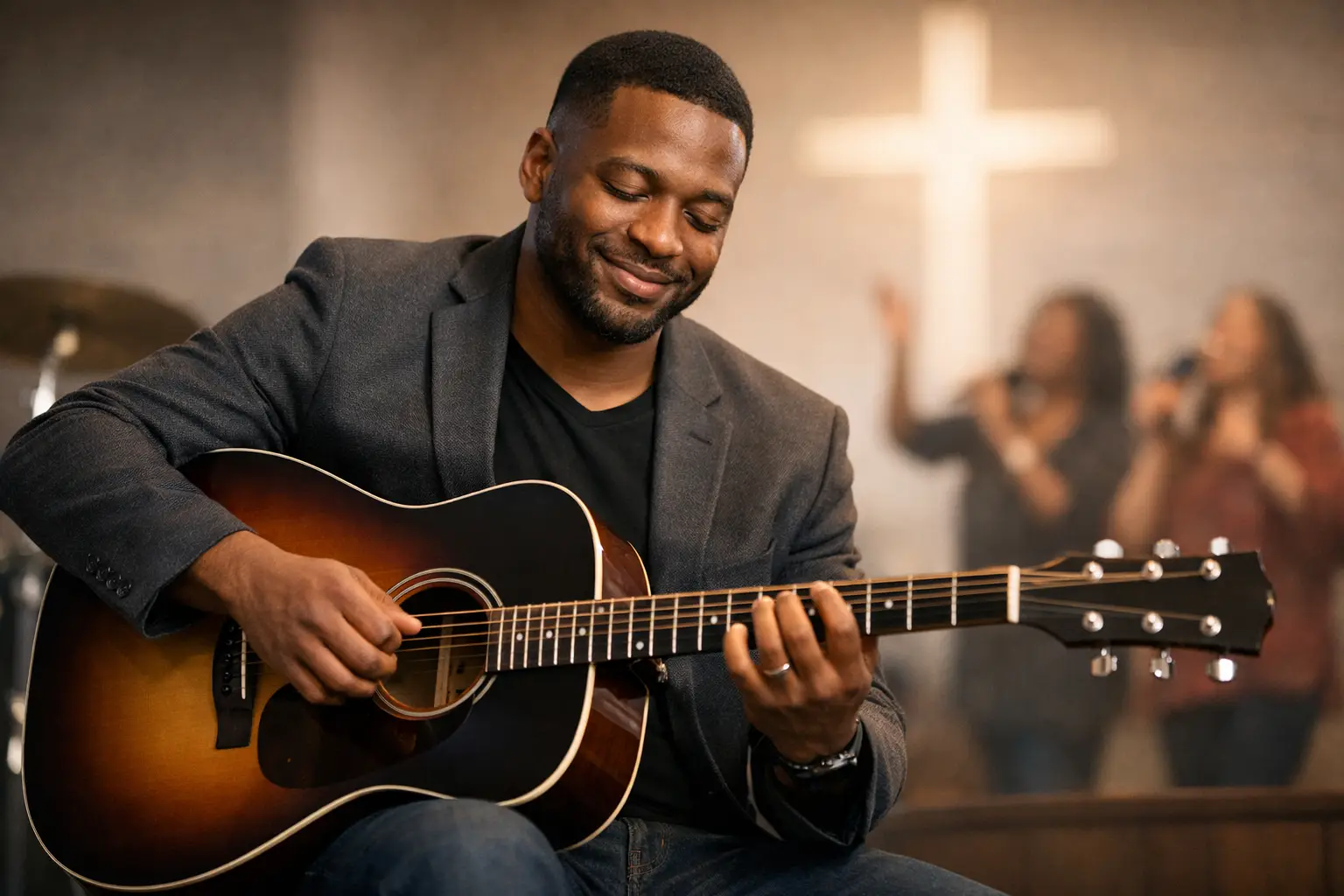
A gospel guitarist can change the feel of a worship song with one well-placed chord. The goal is not to fill every space with notes. It is to support the message, lock in with the rhythm section, and give the vocalist and congregation a strong musical foundation. If you are learning how to play gospel guitar, start by treating it as both a musical skill and a serving skill.
Gospel guitar draws from church hymns, contemporary worship, traditional gospel, soul, blues, and jazz. That is why the harmony can sound rich even when the song uses a simple progression. You do not need to learn every advanced chord before you can contribute. You do need a reliable process for building chords, recognizing movement, developing rhythm, and listening closely in a band.
Start With the Gospel Guitar Foundation
Begin with the open and movable major, minor, dominant seventh, and minor seventh chord shapes you can play cleanly. These are not beginner-only tools. They are the raw material for the fuller voicings you will use later. If a chord buzzes, sounds muted, or takes too long to grab, it will make service playing stressful.
Next, learn the notes on the sixth and fifth strings. This is one of the fastest ways to become useful in different keys. A church band may move a song from G to A because it better supports a singer. When you know where your roots are, barre chords and movable voicings let you follow that change without starting over.
Build your basic number-system awareness at the same time. In the key of C, C is the 1 chord, D is 2, E is 3, F is 4, G is 5, A is 6, and B is 7. Most players will describe chords by quality as well: 1 major, 2 minor, 4 major, 5 major, and 6 minor. Once you hear and recognize numbers, the same progression makes sense in every key.
For example, a 1-6-2-5 in C is C-Am-Dm-G. In G, it becomes G-Em-Am-D. This movement appears constantly in gospel, worship, and R&B-influenced church music. Learn the sound, not just the chord names.
How to Play Gospel Guitar With Better Voicings
A full six-string chord is sometimes exactly right, especially when you are the only harmonic instrument. But in a band with keys, organ, bass, and another guitar, full chords can create mud. Gospel guitar often sounds more mature when you play fewer notes with better placement.
Start by moving major and minor triads across the top three or four strings. A triad is simply a three-note chord: root, third, and fifth. These compact shapes are easy to move, they cut through a mix, and they leave room for the bass player to handle the low end.
Then add color with seventh chords. A major seventh can bring a smooth, worshipful lift. A dominant seventh creates pull and often wants to resolve. A minor seventh provides a warm, open sound that fits many 2 and 6 chords. You do not have to use a complicated voicing every time. The best choice depends on what the keyboard player is playing, how full the arrangement is, and whether the moment needs energy or space.
Practice taking a basic progression such as 1-4-5-1 and playing it three ways: with open or barre chords, with compact triads, and with seventh-chord voicings. This teaches you that the progression stays the same even when the texture changes.
A useful next step is voice leading. Instead of jumping to a distant shape for every chord, find the nearest chord shape on the same string set. When individual notes move only a fret or two, your playing begins to sound connected rather than choppy. That smooth movement is a major part of the gospel sound.
Build Rhythm Before You Add More Chords
A player with ten great chords and weak time will struggle more than a player with four chords and a dependable groove. Gospel rhythm is not only about strumming patterns. It is about knowing where the pulse sits, where to leave silence, and how to match the feel of the song.
For a contemporary worship song, you may use steady eighth-note motion, light downstrokes, or ringing chord swells. For a traditional gospel tune, the guitar may need a stronger backbeat, short chord stabs, or a driving shuffle. In a soul-influenced praise section, a syncopated rhythm can add momentum without overpowering the singers.
Practice with a metronome or drum loop, but make the exercise musical. Set a slow tempo and play a 1-6-2-5 progression. First, play whole notes. Then play two beats per chord. Then use short stabs on beats two and four. Finally, alternate between playing and resting for a full measure. The rests will teach you control.
Keep your strumming hand moving even when you do not strike the strings. That motion helps your internal timing stay steady. Muted strums can also become part of the groove, especially in upbeat songs, but use them with intention. A busy rhythm pattern is not automatically a better rhythm pattern.
Learn the Progressions Church Musicians Use
Gospel harmony becomes less intimidating when you stop seeing every song as a brand-new set of chords. Many songs use familiar movements with different tempos, melodies, and arrangements. Train your hands and ears on common progressions until they feel natural.
The 1-4-5 is essential for hymns, praise songs, and simple worship arrangements. The 1-5-6-4 appears throughout modern worship music. The 1-6-2-5 gives you a classic gospel and soul-flavored turnaround. The 2-5-1 is equally valuable because it creates a strong resolution and prepares you for richer substitutions later.
Do not rush into altered chords just because they sound impressive. First, make the basic progression feel good. Then experiment with a passing chord between the 1 and 6, or a dominant chord that leads into the 2. A passing chord should create direction. If it distracts from the vocal line or confuses the band, leave it out.
Learning turnarounds is especially helpful for live worship. At the end of a verse, vamp, or song, the leader may need another moment before moving on. A clean 1-6-2-5 turnaround can help the band stay connected while the room continues singing, praying, or waiting for a cue.
Practice Every Key Without Getting Overwhelmed
Playing in every key is a long-term skill, not a one-week assignment. Start with friendly guitar keys such as G, C, D, E, and A. Learn your core progressions in those keys, including the root notes, basic chord shapes, and one compact voicing option for each chord.
After that, add one less familiar key at a time. Use a capo when it helps you create the right texture or accommodate a singer, but do not let the capo become a substitute for learning the fretboard. In some church settings, a capoed guitar sound is exactly what the arrangement needs. In others, you will need movable shapes because the key changes quickly or the band is playing in a flat key.
A focused weekly practice routine can make this manageable:
- Spend five minutes finding roots and scale degrees in one key.
- Spend ten minutes playing two common progressions with a metronome.
- Spend ten minutes moving triads or seventh voicings through those progressions.
- Spend ten minutes playing along with a worship or gospel recording by ear.
Keep the tempo slow enough that you can hear mistakes and correct them. Speed comes from clean repetitions, not from rushing through shapes.
Serve the Song and the Team
Church guitarists need more than chord knowledge. They need awareness. Before rehearsal, know the song form, the original key, the likely ending, and any planned transitions. During rehearsal, listen for what the keys player, bass player, and drummer are already covering. Your part may be a rhythmic pattern, a high triad line, a few tasteful fills, or simple sustained chords.
Watch the worship leader. A repeated chorus may become a vamp. A spoken prayer may require the band to soften. A spontaneous key change may happen with little warning. You will not catch every cue at first, but preparation and attentive listening make you much more dependable.
When you play a fill, leave space afterward. When the vocalist is delivering an important lyric, simplify. When the band builds, increase intensity through rhythm, register, or chord color instead of just turning up. That kind of restraint is not playing less because you lack ideas. It is choosing the idea that best serves the moment.
Your next breakthrough may come from one small habit: choose a single progression, practice it in two keys, and use it in a real song this week. Build chords, rhythm, and confidence one repeatable step at a time, and your guitar will become a steady, encouraging voice in the worship team.
Leave a Reply