
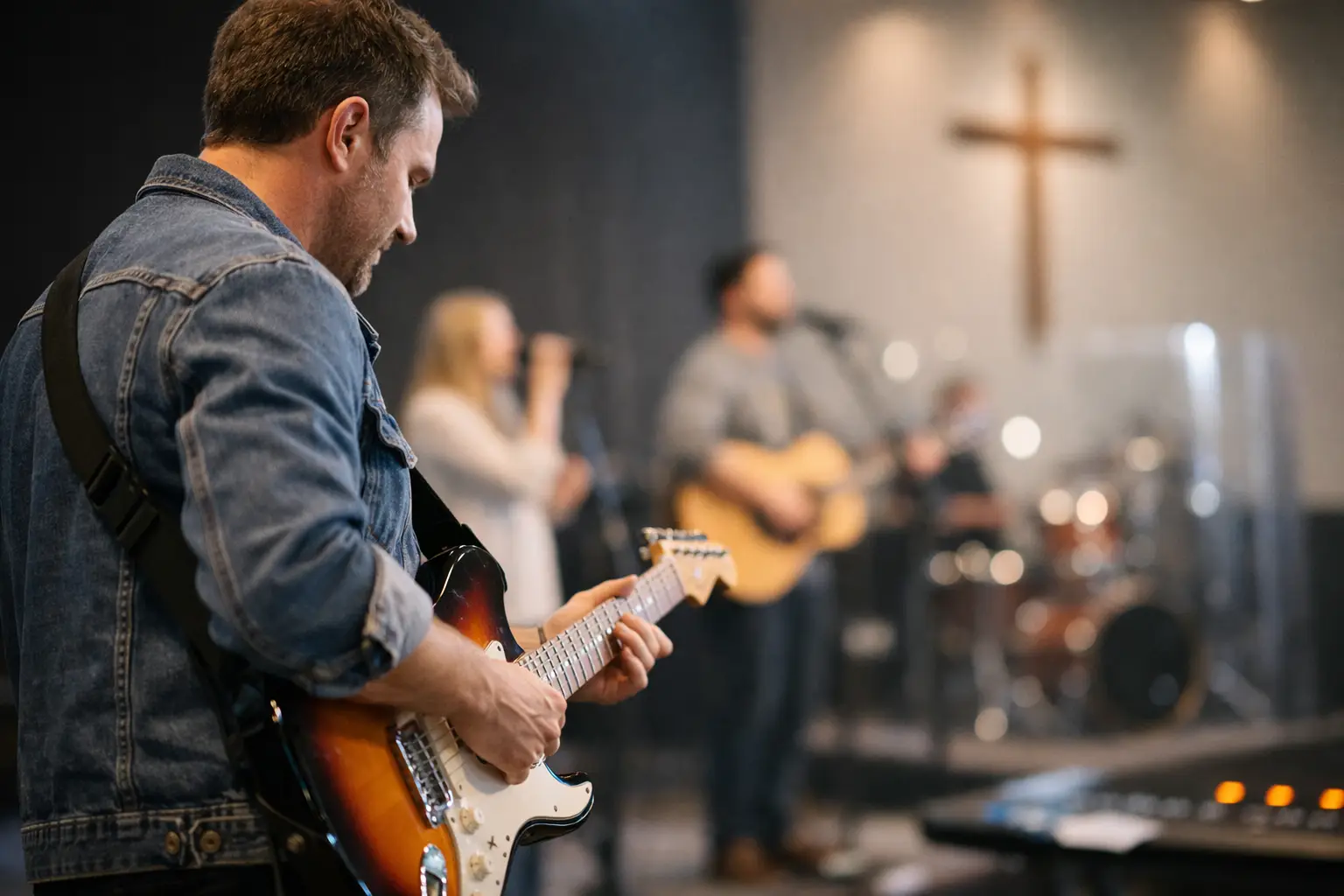
A church guitarist can know every open chord and still feel unprepared when the worship leader changes the song order, the keyboard player adds a passing chord, or the room settles into a quiet moment. Learning how to play guitar in church is not only about learning songs. It is about building chords, rhythm, ears, and confidence so you can support what is happening in the room.
The good news is that church guitar is a learnable discipline. You do not need to play every note, own expensive gear, or imitate every gospel guitarist you hear. You need dependable fundamentals, an understanding of your role in the band, and a practice routine that connects directly to real services.
How to Play Guitar in Church: Start by Listening
Your first responsibility is to listen. In a church setting, guitar is usually one part of a larger musical picture that may include vocals, keys, bass, drums, organ, tracks, and another guitarist. A good part can be simple, but it must leave room for everyone else.
Before you begin playing, identify the song’s key, tempo, feel, and arrangement. Ask yourself what the band needs from guitar in that moment. During a soft verse, that may be a few gentle triads or sustained chord colors. During a strong chorus, it may be a clear rhythmic pattern that supports the drums. If the keyboard or organ is already filling a lot of harmony, your best choice may be to play less.
This approach can feel unfamiliar if you have learned guitar mainly as a solo instrument. In church, tasteful restraint is musical maturity. Your goal is not to prove that you know more chords than the rest of the band. Your goal is to make the song, the singers, and the congregation feel supported.
Build a Church-Ready Chord Foundation
Open-position major, minor, seventh, and suspended chords are a useful starting point, especially for acoustic guitar. But church and gospel music often calls for richer harmony than basic chord shapes can provide. Begin adding movable chord forms and smaller voicings high on the neck.
Start with major triads on the top three or four strings. Learn the same major chord in several locations, then do the same with minor triads. These compact shapes are easier to place around a singer’s range and less likely to crowd the bass player or keyboardist. They also help electric guitar sit clearly in a full worship band.
From there, add the chord colors you hear often in gospel and worship music: major seventh, dominant seventh, minor seventh, add9, sus2, sus4, and sixth chords. You do not need to memorize dozens of shapes in one week. Choose one chord family, use it in a familiar song, and learn how it sounds in context.
For example, a basic I-IV-V progression in G is G-C-D. Once that feels comfortable, practice options such as Gmaj7, Cadd9, and Dsus4. The harmony becomes more expressive without making the part difficult to play. That is the kind of practical vocabulary that helps you move from general guitar playing to church-ready musicianship.
Learn Numbers, Not Just Chord Names
The Nashville number system is one of the fastest ways to become more flexible at rehearsal. Instead of thinking only in named chords, understand each chord’s role in the key. In G, G is the 1 chord, C is the 4, D is the 5, and Em is the 6 minor.
When a worship leader says, “Let’s go from the 1 to the 6 to the 4,” you can respond quickly if you know the numbers. It also makes transposing much easier. A 1-5-6m-4 progression in G is G-D-Em-C. In D, it becomes D-A-Bm-G. The pattern stays the same even though the chord names change.
Practice common movements in at least a few keys every week. Start with the guitar-friendly keys of G, D, C, E, and A, then work toward Bb, Eb, Ab, and Db. Gospel services often move through keys that may not feel natural at first, particularly when the band follows a vocalist’s preferred range. A capo can be useful, but it should be a tool rather than a substitute for learning the neck.
Develop Rhythm That Serves the Song
Church guitar rhythm is more than down-up strumming. Your rhythm needs to match the style, energy, and pocket of the band. A modern worship song may call for a steady eighth-note pattern, while a gospel praise song may need syncopated chord stabs that lock with the snare and bass.
Practice with a metronome or drum loop, but do not only practice at one tempo. Begin slowly enough that every stroke feels controlled, then raise the tempo in small steps. Count out loud when necessary. If you cannot explain where beat 1 is, it becomes hard to recover when the band repeats a section or changes the arrangement.
Pay close attention to space. Often, the strongest rhythm part is not continuous strumming. Try playing on beats 2 and 4, answering a vocal phrase with a short chord stab, or muting your strings between hits. These choices create movement while keeping the vocal message clear.
Electric players should also practice palm muting, light muting with the fretting hand, and clean chord releases. Acoustic players should work on dynamic control. A soft verse should actually sound softer than a chorus. Volume changes are part of your musical communication, not an afterthought.
Learn the Service Flow, Not Only the Set List
A church service rarely follows a recording exactly. A worship leader may repeat a chorus, extend a vamp, change the key, stop the band for prayer, or return to a previous song. This is where prepared guitarists stand out.
At rehearsal, write down more than chord charts. Mark intros, stops, repeats, modulations, transitions, and any specific cues from the leader. Notice whether the song ends on a held chord, a repeated progression, or a planned tag. If there is a spontaneous section, ask what key and progression the team normally uses.
Also, learn to watch. Leaders often communicate with a hand signal, a nod, a lifted foot, or eye contact. Drummers may signal a build or a stop through their playing. Keeping your eyes up between phrases helps you respond instead of getting lost in the chart.
When you are unsure, simplify. Play the root movement as a clean chord rhythm, stay with the drummer’s pulse, and listen for the next clear cue. A simple part played in time is far more useful than an advanced fill played in the wrong section.
Rehearse Like a Reliable Band Member
Confidence on Sunday is usually built during the week. Listen to the planned songs enough times that you can hear each section in your mind. Practice difficult transitions separately, especially chord changes that happen quickly or keys that require unfamiliar voicings.
Come to rehearsal with your instrument tuned, your capo and picks ready, and your charts organized. If you use pedals or an amp, set a basic clean tone before the rehearsal begins. Church guitar tones generally work best when they are clear, warm, and controlled. Too much gain, delay, or volume can make a good part disappear into the mix.
A helpful weekly practice plan can include four areas:
- Review the songs and identify their keys, numbers, forms, and difficult transitions.
- Practice one set of triads or chord voicings in several keys.
- Play rhythm exercises with a metronome, focusing on steady time and clean rests.
- Work on one common gospel progression, turnaround, or worship vamp by ear.
This does not need to take hours every day. Thirty focused minutes can produce more growth than an unfocused two-hour session. The key is to practice skills you will actually use with people.
Use Fills and Turnarounds With Wisdom
Gospel guitar has a rich language of passing chords, slides, chord melodies, and turnarounds. These ideas can bring life to a service, but timing matters as much as vocabulary. A fill should lead into the next phrase, answer an open space, or strengthen a transition. It should not compete with the vocalist during an important lyric.
Start by learning short, repeatable phrases in one key. A simple walk from the 1 chord to the 4 chord, or a turnaround from the 6 minor through the 2 and 5 back to the 1, can serve dozens of songs. Learn the notes, but also learn when to leave them out.
If you play alongside keys, coordinate your register. Let the keyboard player own the fuller middle range while you use higher triads, rhythmic accents, or a melodic answer. If you are the only chordal instrument, you may need to provide more harmonic information. It depends on the team, the room, and the arrangement.
Serve With Preparation and Humility
Playing guitar in church is both a musical assignment and a shared responsibility. Be early, be ready, and be teachable. Receive feedback without becoming discouraged, and give the band the same patience you hope to receive while you are learning.
Your growth will not always sound dramatic from week to week. Sometimes progress looks like holding steady time through an unfamiliar song, finding the right chord after a key change, or choosing silence at the right moment. Those are real wins. Keep building your chords, rhythm, and ears, and let faithful preparation turn into calm confidence when it is time to play.
Leave a Reply