
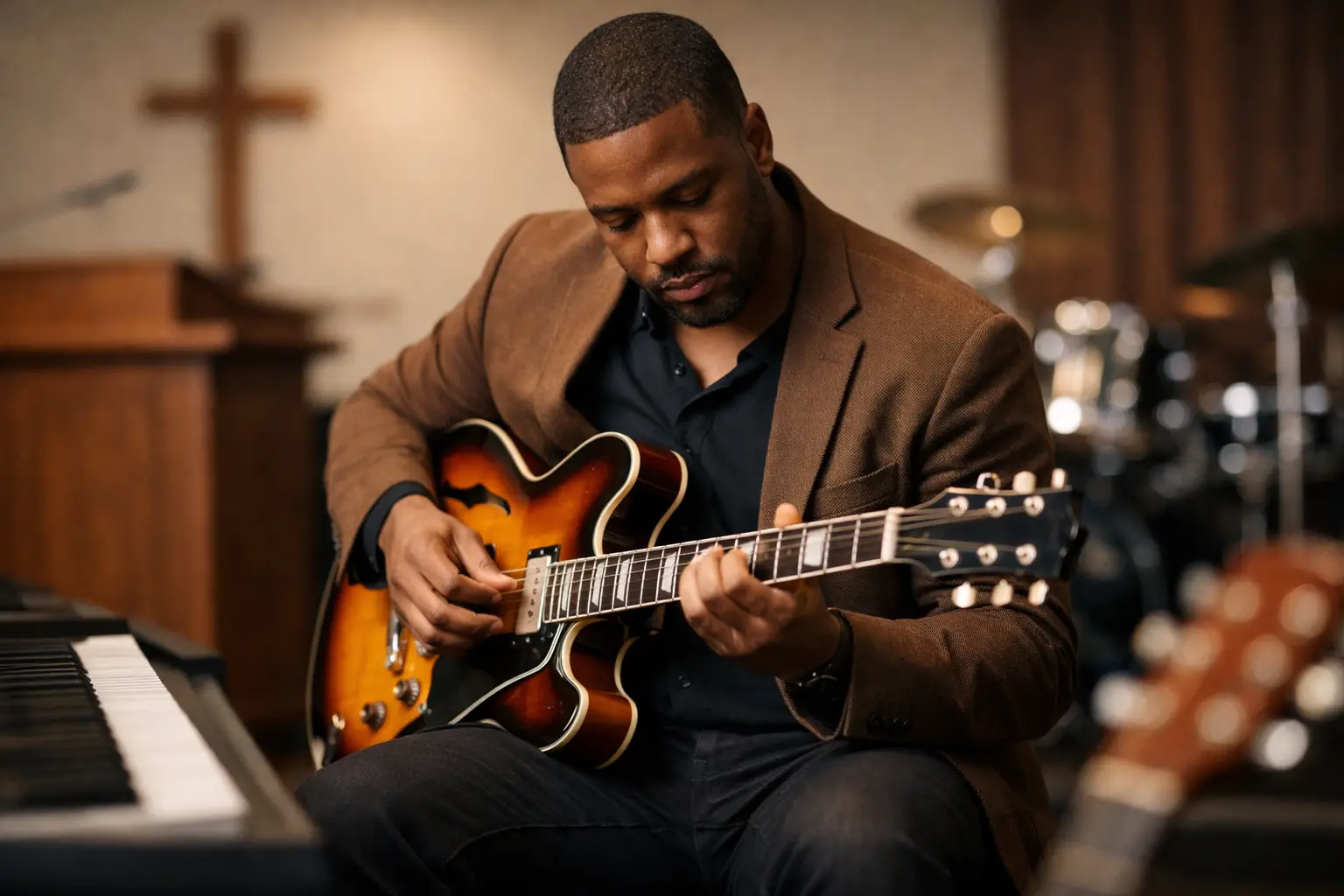
A worship leader calls a song in B, the keyboard player moves the vamp to Eb, and suddenly the shapes you practiced in G do not feel very useful. That moment is why learning to play gospel guitar in every key matters. It is not about showing off theory. It is about being ready to support the room, follow the band, and keep your part musical when the key changes.
You do not need to memorize hundreds of random chord diagrams to get there. You need a repeatable system: know the number of each chord in a key, build a few dependable voicing families, and practice the progressions that appear constantly in gospel and worship music. Start with those pieces, and unfamiliar keys become workable much faster.
Start With Numbers, Not Chord Names
Church musicians often communicate quickly. Someone may say, “Take it from the four,” “Go to the six,” or “We are doing a 1-6-2-5 turnaround.” If you only think in letter names, every change requires mental calculation. If you think in numbers, you can move the same musical idea into any key.
In a major key, the scale degrees give you the basic chord map: 1 major, 2 minor, 3 minor, 4 major, 5 major or dominant, 6 minor, and 7 diminished. In Bb, that means Bb is the 1, Cm is the 2, Dm is the 3, Eb is the 4, F is the 5, and Gm is the 6.
A common 1-6-2-5 progression in Bb is Bbmaj7 – Gm7 – Cm7 – F7. In C, the same progression is Cmaj7 – Am7 – Dm7 – G7. The chord names change, but the sound and function stay the same. That is the mental shift that helps you play with confidence in rehearsals.
Do not rush past the major scale. Spend time saying the numbers out loud while you play them in each key. Then name the chords that belong to each number. This may feel slow at first, but it removes guesswork when a singer changes the key during a service.
Learn the Keys Church Bands Actually Use
Eventually, every key should be available to you. Still, you do not have to attack all 12 keys with equal intensity on day one. Build momentum by starting with keys you are likely to hear in church settings: G, C, D, A, E, Bb, Eb, F, Ab, and Db.
Flat keys deserve special attention. Keyboard players and horn players often feel at home in Bb, Eb, Ab, Db, and Gb, while guitarists tend to stay in open-position keys. If you can play tasteful parts in Bb and Eb without freezing, you immediately become more useful in many gospel settings.
The trade-off is that some keys are less comfortable on guitar if you depend only on open chords. That is exactly why movable shapes and small chord fragments are so valuable. They let you keep the same voice-leading idea without needing an open-string shape for every chord.
Build Movable Gospel Voicings
Full six-string chords have their place, especially when you are the only harmony instrument. But in a band with keys, bass, vocals, and possibly another guitarist, large chords can make the mix crowded. Gospel guitar often sounds stronger when you use clean, movable voicings on the middle and top strings.
Start with major 7, minor 7, dominant 7, minor 9, and dominant 9 shapes rooted on the sixth and fifth strings. You do not need ten versions of each chord right away. Learn two usable shapes per chord quality, then learn where the root is inside each shape.
For example, take a fifth-string-root major 7 shape and move it chromatically up the neck. Say the chord names as you go: Bbmaj7, Bmaj7, Cmaj7, Dbmaj7, and so on. Repeat that same process with a minor 7 and dominant 7 shape. You are building a physical map of the fretboard, not merely collecting grips.
Shell voicings are another practical tool. A shell usually contains the root, third, and seventh, which are the notes that clearly identify the chord’s quality and function. A guitarist playing a compact F7 shell can support a 5 chord without competing with the keyboard player’s fuller harmony. Add a ninth or thirteenth when the arrangement has room, but make the basic sound clear first.
Keep the Top Note Moving Smoothly
Gospel harmony is not only about choosing impressive chord names. It is about how one chord moves into the next. When you practice a 1-6-2-5, look for the nearest possible note on the top string rather than jumping to a distant shape every time.
In Bb, try Bbmaj7 – Gm7 – Cm7 – F7 with all four chords in one small area of the neck. Listen to the top note. If it moves by a half step or whole step between chords, the progression will often sound connected and intentional. That smooth movement is called voice leading, and it is one of the fastest ways to make simple chords sound more mature.
The same principle applies to passing chords. A diminished chord, a dominant approach chord, or a quick chromatic slide can add color, but it should lead somewhere. If it interrupts the vocal, clashes with the keys, or makes the beat feel uncertain, leave it out. Tasteful gospel guitar serves the progression before it serves the guitarist.
Practice Gospel Guitar in Every Key Through Progressions
Practicing isolated chords is necessary, but it will not fully prepare you for service flow. Progressions teach you how chords behave under real musical pressure. Pick one progression and move it through all 12 keys before adding another.
The 1-6-2-5 is a strong starting point because it appears in turnarounds, intros, endings, and transitions. After that, work on 1-4-5, 6-2-5-1, 4-5-3-6, and 2-5-1. Play each progression slowly enough to make clean changes, then add a steady groove.
Use a simple practice sequence:
- Choose one progression and play it in four keys for five minutes.
- Move through those keys using the circle of fourths: C, F, Bb, Eb, Ab, Db, Gb, B, E, A, D, G.
- Use one voicing set for the first pass, then find a second area of the neck for the same progression.
- Finish by playing along with a drum loop or metronome and keeping the rhythm steady.
The circle of fourths is especially useful because it reflects common harmonic movement. If you can follow it musically instead of treating it like a memorization exercise, you will hear more turnarounds before they happen.
Train Your Rhythm Alongside Your Harmony
A player can know every chord in the book and still struggle in a worship band if the rhythm is not dependable. When you change keys, keep the groove simple at first. Do not let the difficulty of finding chords cause your right hand to stop.
Practice a muted sixteenth-note motion while changing between chord shells. Then let selected strums speak on the beat or just before it. This gives you a controlled, percussive gospel feel without filling every space. In slower worship songs, try light swells, broken chord stabs, or sustained upper-string voicings instead of constant strumming.
Listen closely to the drummer and bass player. If the drummer lays back, your chord punches may need more space. If the keys player is using a busy piano pattern, a short guitar response can be more helpful than a full rhythm part. There is no one gospel rhythm that fits every song. The right choice depends on the arrangement, the room, and what the other musicians are already saying.
Prepare for Real Rehearsals and Services
The best test of your key knowledge is not whether you can play a scale alone. It is whether you can enter at the right time, find the next chord, and recover calmly when the arrangement changes.
Before rehearsal, write the song in numbers alongside the chord names. Mark the intro, verse, chorus, vamp, modulations, and likely ending. If the song is in Ab, do not only write Ab, Db, and Eb. Label them 1, 4, and 5 as well. That way, if the leader raises the song to A, you can translate the structure instead of relearning the whole chart.
When a modulation happens, listen for the chord that establishes the new home. Gospel songs may move up by a half step, whole step, or fourth, especially near a final chorus. You do not always need to play a flashy transition. Often, landing cleanly on the new 1 chord with the right rhythm is the most musical response.
Give yourself permission to simplify in the moment. If a new key catches you off guard, play a clear triad, shell voicing, or single-note line that supports the harmony. A simple part played on time is more valuable than a complicated voicing played late.
Every key becomes less intimidating when you meet it through the same process: numbers, movable voicings, familiar progressions, and steady rhythm. Keep bringing that work into actual songs. Over time, you will stop seeing Bb, Eb, or Db as problem keys and start hearing them as another place to serve the song with confidence.
Leave a Reply