
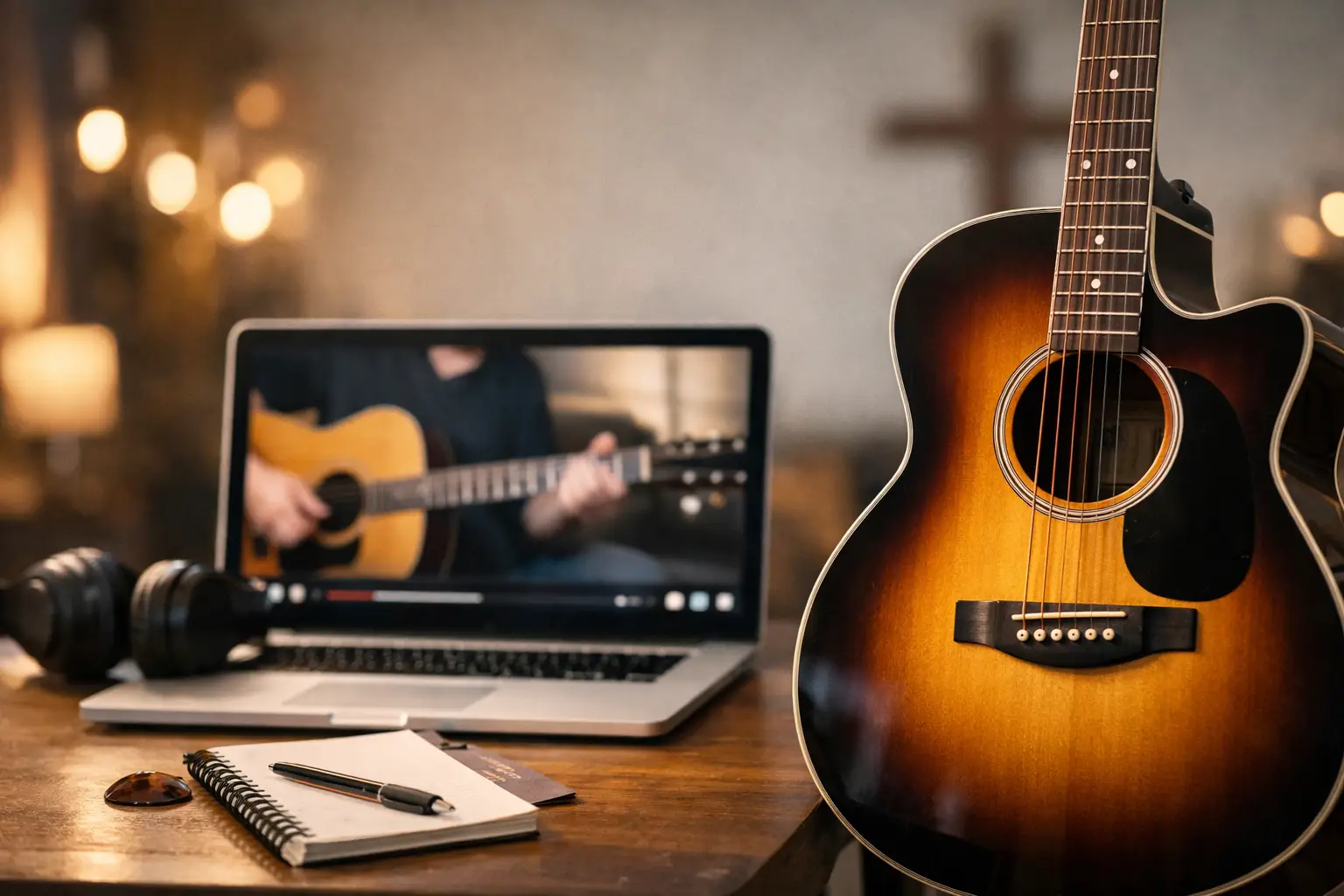
The best gospel guitar course online is not necessarily the one with the most videos or the flashiest player. It is the one that helps you hear a chord movement, find your place in the key, choose a useful voicing, and support the room when the worship leader changes direction. That is a different goal from simply learning more guitar.
For church guitarists, a good course should turn practice time into dependable musicianship. You need material you can use at rehearsal, during a vamp, behind a prayer moment, or when the band calls a familiar progression in an unfamiliar key. Here is what to look for before you commit your time and money.
What a Gospel Guitar Course Should Actually Teach
A general guitar course can improve your technique, but gospel and worship settings ask for a specific musical vocabulary. Open-position chords and a few pentatonic shapes may get a beginner started, but they will not fully prepare you to play with keys, bass, drums, singers, and another guitarist.
The strongest gospel courses teach the connection between harmony, rhythm, and service awareness. You should be learning why a progression works, not only copying one shape from a video. When you understand the numbers behind a movement, you can recognize it in any key and adjust when the song changes.
Chords that work in a band
Look for instruction on major seventh, minor seventh, dominant, diminished, suspended, and added-color chords. More importantly, the course should show where to place those chords on the neck and when to use them.
A beautiful, low-register chord can sound full by itself but muddy next to a keyboard player and bassist. Church-ready instruction addresses that problem. It teaches higher voicings, partial chords, triads, inversions, and chord shapes that leave space for the rest of the band.
Progressions in every key
Gospel guitar is full of recognizable movement: the 1-6-2-5, 3-6-2-5, walk-downs, passing diminished chords, turnarounds, and movements into the four or five chord. A course should help you see those ideas as numbers first, then apply them in real keys.
This matters because songs are often moved to fit a singer. If you only know a progression in G, a key change to A-flat can stop you cold. If you understand the chord function and have workable voicings nearby, you can stay calm and serve the song.
Rhythm and groove, not just chord diagrams
Many players know enough chords but still feel uncertain when the drummer starts playing. That usually means rhythm has not been taught with enough detail.
A useful course should cover strumming patterns, muted strokes, syncopation, chord stabs, pocket, dynamics, and how to lock with the kick and snare. Gospel guitar is often less about playing continuously and more about placing the right rhythm in the right space. A simple two-chord part with conviction and good timing will often serve better than a busy run.
How to Tell Whether a Course Fits Your Level
The right course depends on where you are now, not where you hope to be six months from now. Honest placement saves frustration.
If you are a beginner
Start with a course that assumes you are still building fundamental coordination. You should see clear help with tuning, chord charts, basic major and minor chords, clean changes, simple rhythm, and the Nashville number system.
Do not avoid gospel harmony because it looks advanced. Instead, find a teacher who introduces it in layers. You might begin with a simple I-IV-V progression, then add a seventh chord, then learn a practical passing chord. That approach builds confidence without pretending the music is shallow.
Be cautious of courses that rush beginners into large chord libraries before they can keep time. Your first goal is to play a steady, musical part through a complete song.
If you are an intermediate player
Intermediate players often know standard chords and scales but need a map for gospel movement. This is where a structured course can make a major difference.
Look for lessons on inversions, triads across string sets, voice leading, chord substitutions, turnarounds, playing in all 12 keys, and rhythm parts for common worship progressions. You should also expect assignments that make you apply a concept to a song rather than simply memorize a grip.
At this stage, transcription and ear training matter too. Can you hear whether the band moved to the four chord? Can you identify the bass player walking from the one to the six? A course that develops your ears alongside your hands will make you far more adaptable in live settings.
If you already play on a worship team
Experienced players need more than another collection of chord shapes. Look for material that addresses arranging, dynamics, service flow, band communication, and tasteful improvisation.
The best instruction for this level explains when not to play. It helps you choose whether a song needs acoustic-style rhythm, electric swells, short chord punches, melodic fills, or silence. It should also prepare you for practical moments: following a leader into an unplanned vamp, supporting ministry time, or making a key change without distracting the congregation.
Signs You Are Looking at the Best Gospel Guitar Course Online
Course marketing can make every program sound complete. Instead of judging by promises alone, examine how the lessons are organized and demonstrated.
First, look for a clear learning path. A course does not need to be rigid, but it should answer, “What do I learn first, and what should I be able to do next?” Random video libraries can be helpful for solving one problem, yet they often leave players with gaps.
Second, check whether the teacher demonstrates ideas in musical context. A lesson on a dominant chord is better when you hear it inside a progression. A lesson on a rhythmic pattern is stronger when it is played with a backing track or band feel. Context teaches judgment.
Third, pay attention to the teaching pace. Gospel harmony has depth, but confusing instruction is not a sign of advanced content. The teacher should slow down for finger placement, explain chord function in plain language, and repeat an idea in more than one key.
Finally, consider practice support. Downloadable chord charts, diagrams, play-along tracks, practice plans, and progression exercises can be valuable because they move the lesson off the screen and into your hands. The format matters less than whether it helps you practice consistently.
Watch for These Common Gaps
Some courses use “gospel” to describe a handful of colorful chords without teaching the musical language around them. Others focus heavily on soloing while giving little attention to rhythm guitar and accompaniment. Both can be enjoyable, but neither may solve your church-band needs.
Also be realistic about style. Traditional gospel, contemporary worship, praise and worship, neo-soul influenced gospel, and gospel blues overlap, but they are not identical. A course may be excellent and still lean toward a style that does not match your church. Listen to the examples and ask whether you can imagine using those sounds in your setting.
A course is also not a substitute for playing with people. Online lessons can teach vocabulary and preparation, but rehearsals teach listening, restraint, cues, tempo control, and recovery when something changes. Choose instruction that points you toward real musical application rather than keeping you in practice mode forever.
Get More From Any Course You Choose
Even the right program will only help if you turn lessons into a routine. Give each new progression a practical assignment. Play it in at least three keys. Use a metronome or drum loop. Then try to place it inside a worship song you already know.
Keep a small notebook or digital practice document with the keys you struggle with, voicings that sound good, and turnarounds you want to retain. Over time, this becomes your personal church-guitar vocabulary. You are no longer trying to remember a video. You are building a usable language.
If you are learning with Learn Gospel Guitar resources or another course, resist the urge to collect every lesson before working one idea deeply. Spend enough time with a progression that your hands can find it while your ears stay on the band.
The goal is not to impress people with how many chords you know. It is to become the guitarist who can listen well, play with conviction, and bring the right sound when the moment calls for it.
Leave a Reply