
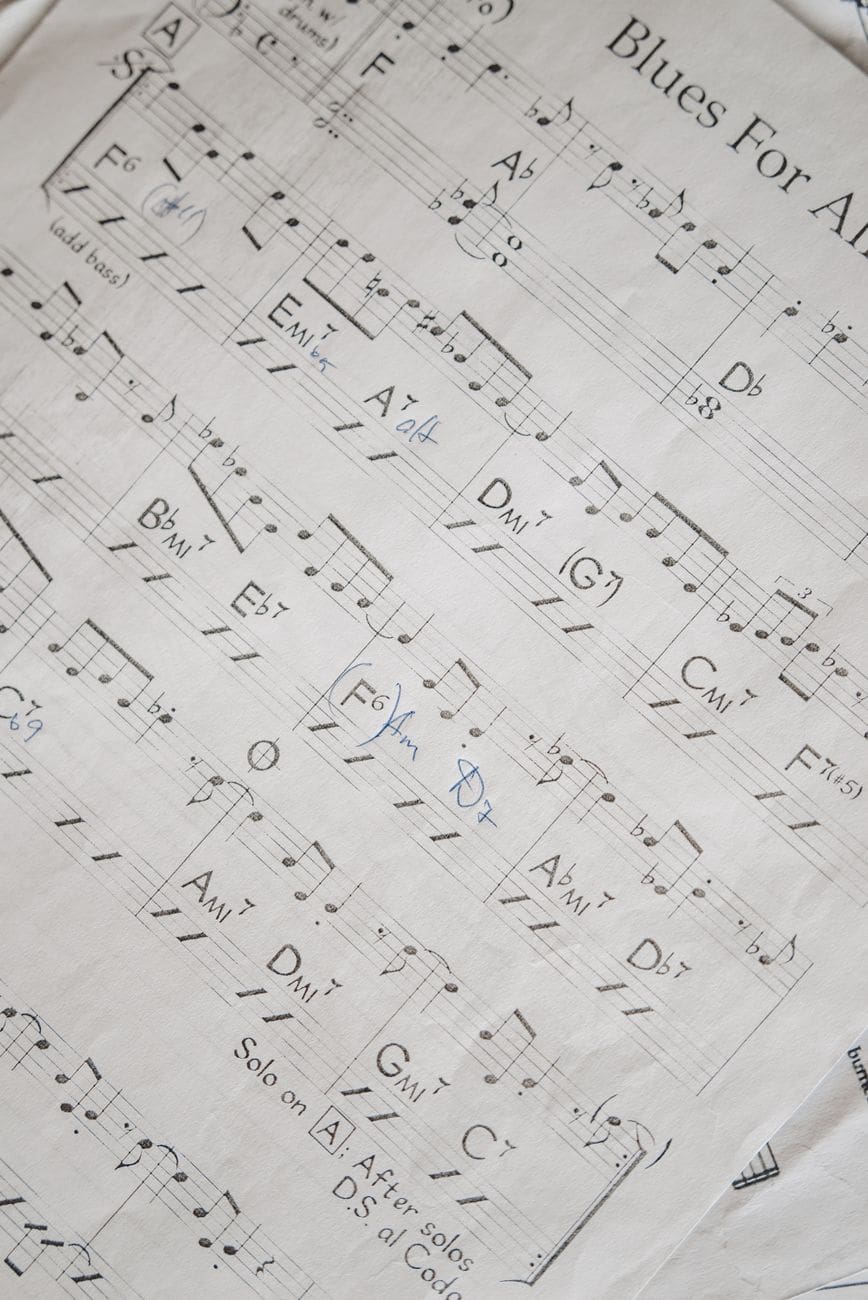
Song chord sheets are among the most useful tools a musician can keep close at hand. They give you the harmonic roadmap of a song without forcing you to read a full score, memorize every measure, or sort through a page crowded with unnecessary information. For guitarists, pianists, singers, worship musicians, songwriters, teachers, and working bands, a clear chord sheet can turn an unfamiliar song into something playable within minutes.
The basic idea is simple: a song chord sheet shows the chords in the order they appear, usually organized by sections such as the intro, verse, chorus, bridge, and ending. A well-designed chart may also include the key, time signature, tempo, repeated sections, rhythmic cues, and performance notes. It gives players enough information to understand the structure and harmony while leaving room to interpret the music in their own style.
This guide explains what song chord sheets are, how they differ from other forms of music notation, how to read them, how to create better charts, and how a dedicated chord sheet app can make learning, rehearsing, and performing songs much easier.
Quick Answer
A song chord sheet is a simplified roadmap that shows a song’s chords, timing, and section order. Musicians use chord sheets to learn songs faster, change keys, communicate arrangements, and perform without reading a full score.
Key Takeaways
- Chord sheets prioritize harmony and song structure over note-for-note notation.
- Clear section labels, bar lines, key information, and concise notes make charts easier to use.
- Transposition and Nashville numbers let the same progression work in multiple keys.
- A searchable digital library prevents duplicate, outdated, and misplaced charts.
What Is a Song Chord Sheet?
A song chord sheet is a simplified written representation of a song’s chord progression and form. Instead of displaying every note for every instrument, it focuses on the harmonic information musicians need to accompany the song.
A basic chart might look like this:
Intro: C | G | Am | F
Verse: C | G | Am | F
Chorus: F | C | G | Am
That small amount of information tells a musician which chords to play and in what order. The player supplies the rhythm, voicing, strumming pattern, groove, and dynamics based on the style of the song.
Some song chord sheets place chord symbols above lyrics. Others are lyric-free and use measures, slashes, or section labels. Lyric-free charts are especially useful when musicians need a compact reference that can fit on one screen or page. They also keep the focus on structure rather than encouraging the player to stare at every word during a performance.
Why Musicians Use Chord Sheets
Chord sheets are popular because they balance detail and simplicity. A full arrangement may be too dense for a casual rehearsal, while a memorized progression may be too easy to forget under pressure. A chord sheet gives players a reliable reference without dictating every musical decision.
They are useful in many situations:
A beginner can use a chord chart to practice changing between common chords. A singer can identify a comfortable key and communicate it to an accompanist. A songwriter can document a new progression before forgetting it. A worship team can prepare several songs for a service. A cover band can organize a large repertoire. A music teacher can provide students with clear practice material. A substitute musician can learn a set quickly before a gig.
The best song chord sheets reduce uncertainty. They help everyone agree on the same key, arrangement, section order, and ending. That alone can save a surprising amount of rehearsal time.
The Main Parts of a Chord Sheet
Most useful chord sheets include several core elements. The title identifies the song. The artist or writer name helps distinguish between songs with similar titles. The key tells players the tonal center. The section labels show the structure. The chord progression gives the actual harmonic movement.
Additional information can make a chart even more practical. A tempo marking helps establish speed. A time signature such as 4/4 or 6/8 clarifies the meter. A capo note helps guitarists use easier chord shapes while sounding in the correct key. Repeat symbols or notes such as “x2” prevent unnecessary duplication. Short arrangement notes can identify stops, builds, breaks, or a final chord.
A clean chart does not need to include every possible detail. It should include the details that prevent confusion. The goal is not to make the chart look impressive. The goal is to make the song easy to play.
How to Read Chord Symbols
Most chord symbols begin with a letter name from A through G. A plain letter, such as C, usually means a major chord. A lowercase “m,” as in Am, means minor. A number may indicate an added chord tone, such as G7, Cmaj7, or Dm7. Symbols such as sus2, sus4, dim, aug, add9, and slash chords provide additional harmonic information.
A slash chord shows a chord with a specific bass note. For example, G/B means a G major chord with B in the bass. On piano, the left hand may play B while the right hand plays a G chord. On guitar, the player chooses a G voicing that places B as the lowest sounding note.
You do not need to know every advanced chord before using song chord sheets. Start with major and minor chords, then learn dominant sevenths, major sevenths, minor sevenths, suspended chords, and slash chords as they appear in the music you play.
How Measures and Chord Timing Are Shown
A chord name alone tells you what to play, but the chart must also communicate when the chord changes. Many lyric-free chord sheets use vertical bar lines to separate measures. In 4/4 time, one chord written inside a measure usually lasts four beats. Two chords in the same measure often receive two beats each unless the chart indicates otherwise.
For example:
C | G | Am F | C
The first measure is C, the second is G, the third contains Am and F, and the fourth returns to C. A musician would usually play Am for two beats and F for two beats in the third measure.
Some charts use slashes to represent beats. A measure written as C / / / means the C chord continues for four beats. A chart may also use rhythmic notation for important hits or syncopated changes. The more rhythmically specific the song is, the more helpful those details become.
Ready to put this into practice?
Create and transpose your first chord sheet in Chord Sheet Pro
Song Form and Section Labels
Understanding form is one of the biggest benefits of using chord sheets. Popular songs are often built from repeating sections. A chart may contain an intro, verse, pre-chorus, chorus, turnaround, bridge, solo, breakdown, and outro.
Section labels let musicians see the big picture. Instead of treating a song as a long chain of unrelated chords, they can recognize that the same eight-measure verse returns three times or that the final chorus repeats before the ending.
When creating a chart, use clear labels and keep the order easy to follow. If the song has an unusual structure, include a short roadmap at the top, such as:
Intro, Verse 1, Chorus, Verse 2, Chorus, Bridge, Chorus x2, Outro
This can be especially helpful during live performances when players need to anticipate what comes next.
Chord Sheets Versus Tabs and Sheet Music
Chord sheets, guitar tabs, and standard sheet music serve different purposes. Guitar tablature shows where to place your fingers on the fretboard and is useful for riffs, melodies, solos, and specific parts. Standard notation shows pitch and rhythm in detail and can represent complex arrangements for nearly any instrument. Chord sheets focus mainly on harmony and song structure.
A chord sheet is usually the fastest option when you want to accompany a singer, strum through a song, build your own part, or communicate an arrangement to a band. It does not show exactly how the original recording was played, but that flexibility is often an advantage.
Players frequently combine formats. A guitarist may use a chord sheet for the overall song and a short tab for the signature intro. A pianist may use chord symbols while reading a notated melody. A band may use a shared chord chart while each musician adds personal notes about specific parts.
How to Choose the Right Key
The key written on a song chord sheet should match the version you plan to perform. The original recorded key is not always the best choice. A singer may need the song higher or lower. A guitarist may prefer a capo position that uses familiar open chords. A horn player may need a transposed part. A band may combine songs in a medley and choose keys that flow well together.
Transposition changes every chord by the same musical interval. If a song moves from C major to D major, C becomes D, F becomes G, G becomes A, and Am becomes Bm. The relationship between the chords stays the same.
Manual transposition is manageable for short progressions, but it becomes easy to make mistakes in songs with many sections, slash chords, or advanced chord extensions. Chord Sheet Pro can transpose an entire chart instantly while preserving the progression, which is especially useful when testing several vocal keys during rehearsal.
The Nashville Number System
The Nashville Number System replaces chord names with numbers based on their position in the key. In the key of C major, C is 1, Dm is 2m, Em is 3m, F is 4, G is 5, Am is 6m, and B diminished is 7dim.
A progression such as C, G, Am, F becomes 1, 5, 6m, 4. Because the numbers describe relationships instead of fixed chord names, the chart can be moved to another key without rewriting the progression. In D major, the same numbers become D, A, Bm, G.
Number charts are valuable for musicians who work with singers, play in multiple keys, or want to understand harmony more deeply. They also help players recognize recurring patterns across songs. Chord Sheet Pro allows musicians to switch between traditional chord names and Nashville numbers, making it easier to learn the system while still having familiar chord symbols available.
How to Create a Clear Song Chord Sheet
Start by listening to the song and identifying its sections. Write down the form before worrying about every chord. Next, determine the key and find the progression for each section. Count the measures carefully and confirm where changes occur.
Use consistent spacing and measure lines. Keep repeated sections concise. If Verse 2 uses the same chords as Verse 1, you may not need to rewrite the entire progression. Add notes only when they affect the performance, such as “stop on beat 4,” “build,” “half-time feel,” or “repeat chorus.”
Review the chart while playing along with the song. This is the best way to find missing measures, incorrect changes, or confusing formatting. Then test the chart without the recording. A good chart should still make sense when the audio is not there to guide you.
Common Chord Sheet Mistakes
One common mistake is failing to show the correct number of measures. The chords may be right, but the player cannot tell how long each chord lasts. Another mistake is using inconsistent section names or placing repeated sections in a confusing order.
Charts can also become overloaded. Long paragraphs of notes, excessive lyrics, tiny text, and unnecessary chord diagrams may make the page harder to use. A song chord sheet should be readable at a glance, especially during a rehearsal or performance.
Incorrect keys are another frequent problem. A chart may match an online version but not the recording or arrangement the band is using. Always label the key clearly and verify it with the actual version you intend to play.
How Chord Sheet Pro Simplifies the Process
Chord Sheet Pro is designed for musicians who want to spend less time searching, rewriting, and formatting charts. You can create clean chord sheets, organize them into collections, edit or duplicate arrangements, transpose songs, and switch between chord names and Nashville numbers.
Because the app works across devices, your charts can stay available during practice, rehearsals, and performances. A guitarist can prepare a set at home, a singer can request a new key at rehearsal, and the band can use the updated chart without rebuilding it from scratch.
The clean layout is especially valuable on stage. Instead of sorting through screenshots, loose papers, bookmarks, or crowded web pages, you can keep your music organized in one place. Visit Chord Sheet Pro to start building a more useful song library.
A Better Way to Learn and Perform Songs
Song chord sheets are effective because they simplify music without removing the information that matters most. They show harmony, form, and movement while allowing each musician to choose the rhythm, voicing, and style that fit the arrangement.
For beginners, they make songs more approachable. For experienced players, they speed up preparation and communication. For bands, they create a shared roadmap. For songwriters, they preserve ideas. For teachers, they provide clear learning material.
The more organized your chord sheets become, the easier it is to focus on music instead of administration. Build charts that are accurate, readable, and easy to transpose. Label sections clearly. Keep notes purposeful. Store your songs where you can find them quickly.
With Chord Sheet Pro, you can turn scattered chord information into a practical library built for real playing. Create your first chart, organize your favorite songs, and keep the chords you need ready whenever inspiration, rehearsal, or performance begins.
Keep every chart ready for practice, rehearsal, and performance.
Start your organized song library in Chord Sheet Pro
Frequently Asked Questions
What information should a song chord sheet include?
At minimum, include the song title, key, section labels, chord progression, and enough measure or beat information to show when each chord changes. Tempo, meter, capo position, and short arrangement notes can be added when they prevent confusion.
Are chord sheets easier than sheet music?
For accompaniment, rehearsals, and many live performances, chord sheets are usually faster to read because they focus on harmony and form. Standard sheet music is better when exact pitches and rhythms must be reproduced.
Can a chord sheet be used for both guitar and piano?
Yes. Chord symbols describe harmony rather than a single instrument. Guitarists choose chord shapes and strumming patterns, while pianists choose voicings, inversions, and left-hand patterns.
How do you change a chord sheet to another key?
Transpose every chord by the same interval while preserving chord quality, extensions, and bass notes. A chord sheet app can perform the change instantly and reduce manual errors.
Leave a Reply