
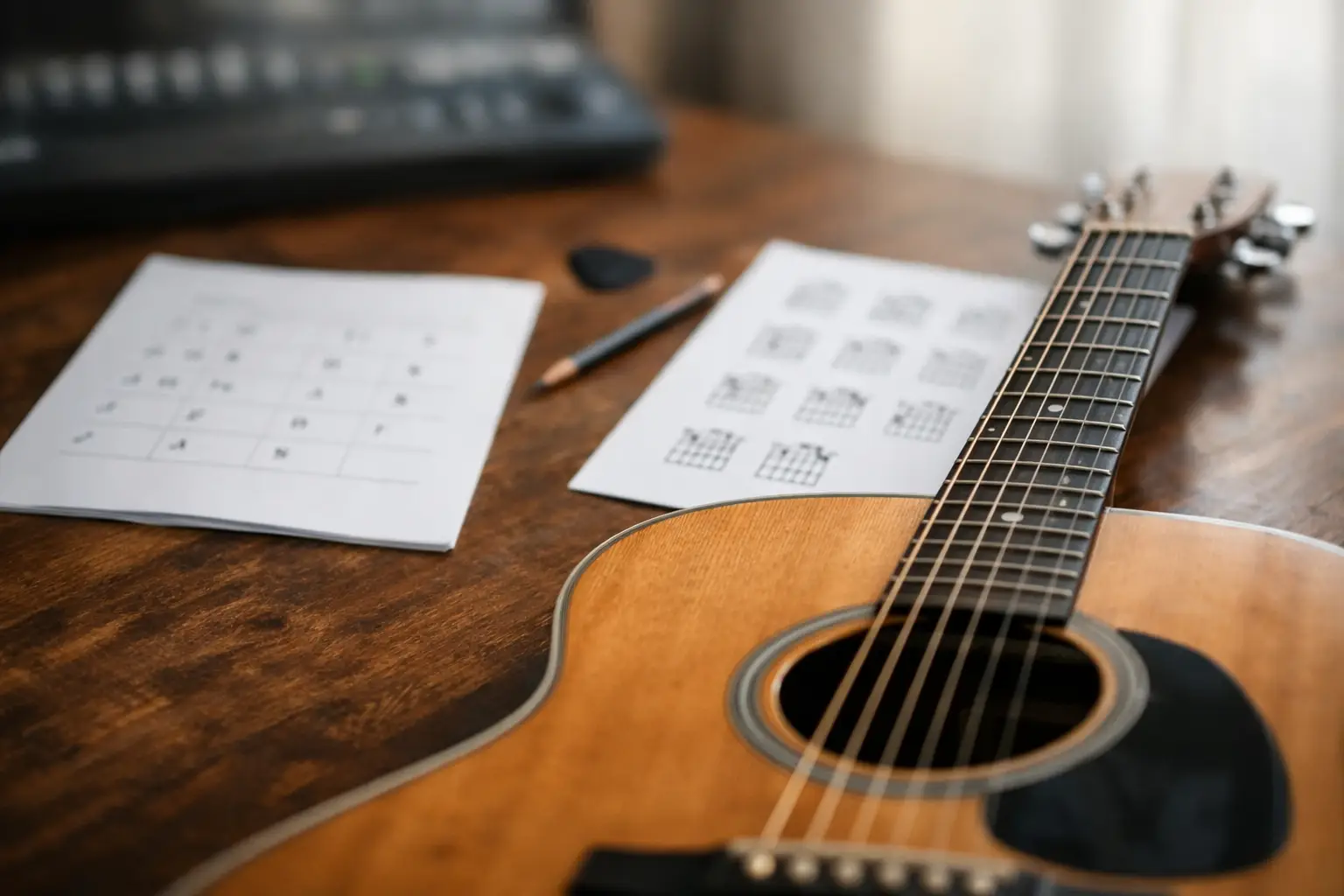
A worship leader calls a song in A instead of G five minutes before service. The keyboard player is already moving through the intro, the bass player knows the walk-up, and you are still translating shapes in your head. This is where Nashville numbers vs chord charts stops being a theory question and becomes a church-guitar skill.
Both systems can help you play with clarity, support the band, and stay ready when a song changes direction. Neither is automatically better. The useful question is: which one gives you the information you need for this moment, with enough speed to serve the music well?
What chord charts do best
A chord chart names the actual chords to play in a specific key. If the song is in G, a simple chart might read:
`G | C | Em | D`
For a newer guitarist, that is immediately useful. You can see the chord names, locate familiar shapes, and begin building a rhythm pattern. In a worship setting, chord charts also make it easy to show details that numbers alone may not communicate clearly: slash chords, altered harmony, written intros, stop-time figures, lyrics, and section-by-section cues.
For example, a chart can tell you that the band is playing `D/F#` rather than a plain D chord. That bass note may matter to the movement of the song, even if your guitar voicing does not need to include it. A well-made chart can also show that the intro uses a specific two-bar figure, the bridge repeats three times, or the final chorus moves into a tag.
That directness makes chord charts an excellent starting point for beginners. If you are learning your first worship repertoire, chord names connect the page to the guitar quickly. They let you practice the actual key you will play on Sunday and begin learning which voicings sound appropriate around keys, pads, bass, and drums.
Where chord charts can slow you down
The weakness of a chord chart is that it can lock your thinking into one key. If you memorize `G – C – Em – D` only as four chord shapes, a last-minute key change can feel like learning a different song.
Chord charts can also become cluttered. A page full of lyrics, capo notes, chord names, arrows, repeat signs, and handwritten corrections may be accurate, but it is not always easy to scan during a live service. That is especially true when a worship leader changes the order, extends a vamp, or asks the band to return to the chorus.
The answer is not to abandon chord charts. It is to understand the progression beneath them.
How Nashville numbers change the conversation
The Nashville Number System labels chords by their position in the key. In G major, G is the 1 chord, C is the 4 chord, Em is the 6 minor chord, and D is the 5 chord. The earlier progression becomes:
`1 | 4 | 6m | 5`
Move the song to A, and the numbers remain the same while the chords become:
`A | D | F#m | E`
That is the central strength of number charts. They reveal the musical pattern, not just the chord spelling. Gospel musicians often work in multiple keys, follow singers with different ranges, and respond to leaders who may call a key change in rehearsal or on the spot. Numbers reduce the amount of mental rewriting required.
For guitarists, this opens a more practical path to playing in every key. Instead of trying to memorize hundreds of unrelated progressions, you learn common movements such as 1-4-6m-5, 1-5-6m-4, 2m-5-1, and 1-6m-2m-5. Then you learn how to build suitable chord voicings for those functions in the key at hand.
In gospel and church music, that functional awareness matters. When you hear a 4 chord preparing a move to 1, or a 2m-5 leading home, you are less dependent on staring at a page. You can anticipate the sound, choose a tasteful voicing, and leave room for the rest of the band.
Nashville numbers vs chord charts in a real rehearsal
Imagine your team is rehearsing a worship song in the key of E. The verse moves from E to A to C#m to B. A chord chart shows exactly that. A number chart shows 1-4-6m-5.
If the worship leader says, “Let’s take it down to D,” the chord-chart reader must quickly convert E, A, C#m, and B into D, G, Bm, and A. A guitarist who understands the numbers already knows the progression has not changed. The 1-4-6m-5 movement simply lives in a new key.
But now suppose the leader says, “On the last chorus, hold the 4, then go back to the 1 for a soft tag.” A basic number chart may show the harmonic instruction, yet it may not tell you exactly how long the band plans to hold it, whether the drums drop out, or which lyric line begins the tag. In that moment, a detailed chord chart with lyrics and arrangement notes may be more helpful.
This is why experienced church musicians often use both. Numbers provide the harmonic map. Chord charts provide the road signs for the particular arrangement.
What each system tells a gospel guitarist
A number chart is strongest when you need to transpose quickly, recognize progressions, communicate in rehearsal, or build fluency across all 12 keys. It trains your ear and your hands to hear chords as functions. If the keyboard player says, “We are going from the 6 to the 2, then the 5,” you can follow the musical language instead of waiting for someone to name every chord.
A chord chart is strongest when the arrangement contains specific written parts. This includes songs with unusual passing chords, detailed turnarounds, instrumental cues, lyric-dependent repeats, and forms that are not easy to predict. It also helps when you are learning a new song and need a concrete reference for the actual chord spellings.
The trade-off is simple: numbers are more portable across keys, while chord charts are often more descriptive in one key. A strong player learns to move between them rather than treating them as competing systems.
Numbers do not replace chord knowledge
A common misunderstanding is that Nashville numbers let you avoid learning chords. They do not. They make chord knowledge more organized.
If a chart says `#4dim7`, you still need to know how that chord functions and how to voice it on guitar. If it says `b7`, you need to know what that means in the current key. If the progression calls for a 3m7, a 6m9, or a 5sus resolving to a 5, numbers tell you the role, but your hands still need the vocabulary.
This is especially relevant in gospel guitar. You may not play every note named on the chart. The keyboard may cover the full harmony, while your job is to add a smaller three- or four-note voicing, a rhythmic stab, or a melodic fill. Numbers help you understand where the harmony is moving. Your voicing choices determine whether your part supports that movement gracefully.
A practical way to learn both systems
Start with songs you already play at church. Take one familiar progression and write it two ways: first as chord names in its original key, then as numbers. Next, move it into two other keys and say the numbers out loud as you play.
For example, practice 1-6m-4-5 in G as G-Em-C-D. Then play it in C as C-Am-F-G, and in D as D-Bm-G-A. Do not rush into fancy chord substitutions. First build the ability to recognize the movement, find the basic chords, and keep steady time.
After that, add gospel-friendly color one function at a time. You might play the 1 as a major 7 or add 9 voicing, use a 6m7 instead of a plain minor chord, or create a smooth inversion on the 4. Keep listening to the bass and keys. A richer guitar chord is only useful if it fits the harmony and leaves space for the ensemble.
It also helps to practice reading forms, not just chords. Take a chart and mark the verse, chorus, bridge, vamp, tag, and ending. Ask yourself what happens if the leader repeats the chorus, cuts the bridge, or changes keys for the final section. The goal is not to predict every service moment. The goal is to become calm enough to listen, adjust, and keep the musical foundation steady.
Which should you bring to church?
Bring the format your team actually uses, and be ready to translate it. If your church relies on lyric chord sheets, learn to read them cleanly. If the band speaks in numbers, make number fluency a priority. If you can prepare both before rehearsal, do it.
A useful personal chart often combines the strengths of each system: numbers for the progression, chord names for the assigned key, and only the arrangement notes you truly need. Keep it readable. Large sections, clear repeats, and a few well-placed cues are more valuable than a page crowded with every possible detail.
Your chart should help you look up more, not down more. The congregation, worship leader, and other musicians need a guitarist who is present enough to hear a transition, follow a spontaneous moment, and play with restraint when the song calls for space.
As you grow, let every chart teach you more than a sequence of shapes. Hear the movement, learn the function, and practice serving it in any key. That kind of preparation builds the confidence that helps a church band breathe and move together.
Leave a Reply