
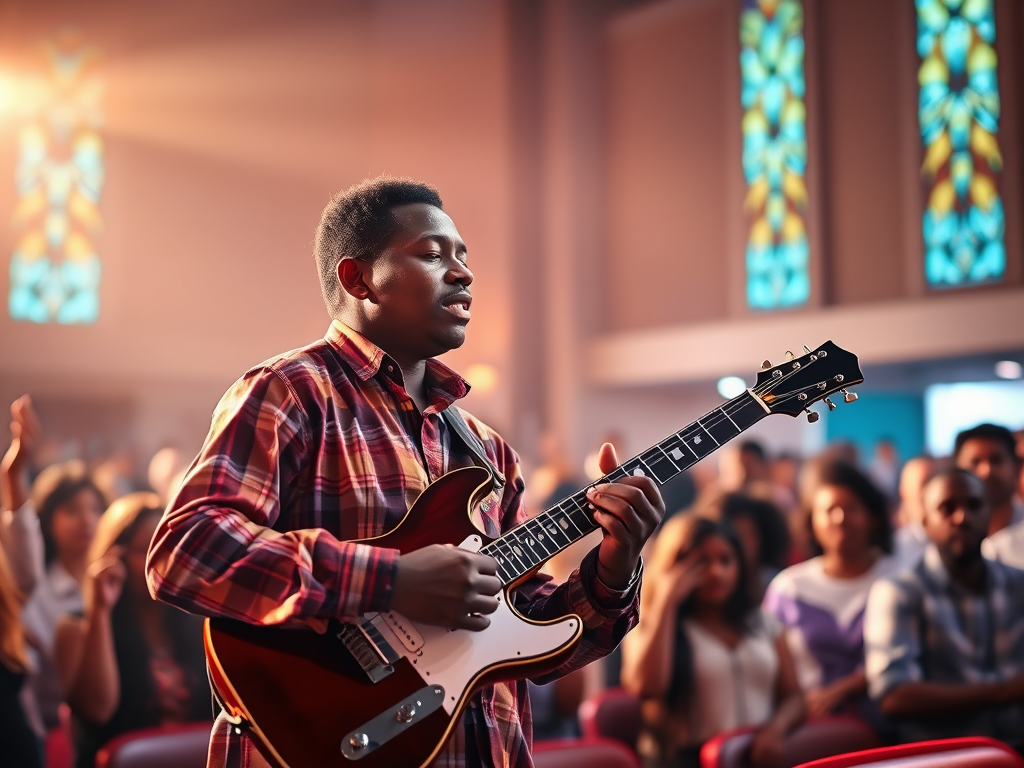
Quick answer: Beginners should start gospel guitar by learning basic major and minor chords, a few simple progressions such as 1-4-5 and 1-6-4-5, smooth transitions between chords, and the habit of thinking in numbers instead of letter names. Gospel guitar differs from other styles in its constant chord movement, its use of the Nashville Number System, and its emphasis on feel. Short, consistent practice with step-by-step lessons is the fastest way to improve.
If you are looking for gospel guitar lessons for beginners, the most important thing to understand is this: gospel guitar is not about how many chords you know. It is about how you move between them and how you make them feel.
This guide shows you where to start, what to learn first, and how to avoid the mistakes that keep most beginners stuck.
👉 Start with free gospel guitar lessons on YouTube
What Makes Gospel Guitar Different?
Gospel guitar shares its chords with many other styles, but it uses them in a distinctive way. Three things set it apart.
1. Chord Movement
In many styles, a song sits on one chord for several bars. In gospel, the harmony keeps moving. Musicians add passing chords, walk-ups, and turnarounds that connect the main chords of a song.
As a beginner, you do not need to play all of that right away. You do need to understand that movement is the goal, so that you practice changing chords smoothly from the start.
2. The Nashville Number System
Gospel musicians think of chords as numbers. In any key, the chords are numbered 1 through 7 according to their position in the scale. A song that goes C, F, G in the key of C is a 1-4-5.
Numbers let a band change keys instantly, which happens often in church. Learning them early is one of the best investments a beginner can make. Nashville Number System for Guitar Players Explained Simply explains the system in plain terms.
3. Feel and Expression
Gospel music is expressive. The way you strum, how long you let a chord ring, and how softly or strongly you play all matter. A simple chord played with good timing and sensitivity sounds better than a difficult chord played stiffly.
👉 Watch these ideas demonstrated on YouTube
What Are the First Things You Should Learn?
Focus on four fundamentals before anything else.
Learn Basic Major and Minor Chords
Start with the open chords most songs use: C, D, E, G, and A major, and A, D, and E minor. Make sure every string rings clearly. Then learn the F and B minor barre chords, which open the door to movable shapes.
Do not rush this stage. Clean chords are the foundation of everything else. 7 Gospel Guitar Chords Every Church Guitarist Must Know shows which chord types to add next.
Understand Simple Progressions
A progression is a sequence of chords. Begin with these:
- 1-4-5 (C, F, G in the key of C)
- 1-6-4-5 (C, Am, F, G)
- 1-5-6-4 (C, G, Am, F)
These three patterns appear in hundreds of worship and gospel songs. Learning them means you already know the framework of much of the music you will play.
Practice Smooth Transitions
The gap between two chords is where beginners struggle most. Practice changing between two chords, back and forth, slowly and in time. Keep your fingers close to the strings and move them together.
Use a metronome at a slow tempo. Strum once per bar and change chords exactly on the first beat. Speed up only when the changes are clean.
Start Thinking in Numbers
As you learn each progression, say the numbers out loud. When you play C, F, G, say “one, four, five.” Then play the same progression in G: G, C, D. Say the same numbers.
You will quickly see that the pattern is identical. This habit prepares you for playing in any key later on.
It also helps you learn songs faster. When someone tells you a song is “a 1-6-4-5 in A,” you will know what to play before you hear a note. Common Gospel Guitar Progressions explains how these patterns are used in worship.
Finally, numbers make it easier to communicate with other musicians. Church bands often call out changes by number during a song, and a beginner who understands the system can follow along from the first rehearsal.
👉 See the number system in action on YouTube
Why Do Most Beginners Get Stuck?
Several habits slow beginners down. The first is trying to learn everything at once. Jumping between advanced chords, licks, and theory before the basics are solid leads to confusion.
The second is practicing without structure. Playing through songs you already know feels good but does not build new skills. The third is ignoring rhythm. Many beginners focus entirely on the fretting hand and never develop steady time.
The fourth is learning songs only by chord name in a single key. That creates dependence on charts and makes key changes frightening. Avoid these four habits, and you will progress much faster than most. Why Beginner Guitarists Stay Stuck for Years looks at these patterns in more detail.
👉 Get a clear starting point on YouTube
What Is the Fastest Way to Improve?
Progress comes from combining three things.
Learn Concepts and See Them Applied
A concept sticks when you see how it is used. Learning that a 1-4-5 exists is useful. Hearing it in a song you sing at church and playing along is far more useful.
Whenever you learn something new, find a real song that uses it. Application is what turns knowledge into ability.
Watch Step-by-Step Lessons
Follow lessons that build in order, from chords to progressions to movement. A structured path removes the guesswork about what to practice next.
Pause often, play along, and repeat sections until you can do what is being shown. One lesson studied carefully is worth more than several watched casually. The series described in Gospel Guitar Foundations: From Beginner to Sunday-Ready is designed for this.
Stay Consistent
Fifteen to twenty minutes every day beats two hours once a week. Your hands and ears learn through regular repetition.
Set a fixed time for practice and keep your guitar where you can reach it easily. Small, steady effort adds up quickly.
👉 Learn gospel guitar step by step on YouTube
What Does a Beginner Practice Routine Look Like?
A simple daily routine might be:
- 5 minutes: chord changes between two chords, slowly, with a metronome
- 5 minutes: one progression in one key, saying the numbers aloud
- 5 minutes: rhythm practice, with one strum per beat, then short muted strums
- 5 minutes: play along with a simple worship song
Stay with one key for a week before adding another. Start with C or G.
Each week, add one small new element: a new chord, a new progression, or a new key. Keep a notebook of what you practiced. For more detail on structuring your time, see How to Practice Gospel Guitar at Home.
After a month, record yourself playing a full song. Listening back will show you how far you have come and what to work on next.
👉 Practice along with beginner lessons on YouTube
What Should You Learn After the Basics?
Once your chords, progressions, and rhythm are steady, you are ready for the next layer.
Add 7th chords: major 7, minor 7, and dominant 7. These bring the warmth associated with gospel. Learn small versions of your chords on the top four strings, which blend better in a band.
Then begin adding movement, with simple walk-ups between chords, the 2-5-1 progression, and your first passing chords. Beginner Gospel Guitar Roadmap: What to Learn First lays out this sequence, and How to Add Gospel Flavor to Basic Guitar Chords gives you easy ways to start sounding like the style.
👉 Continue with the next lessons on YouTube
What Will You Be Able to Do?
With steady practice of these fundamentals, you will be able to play common worship and gospel progressions cleanly, change chords in time without stopping, understand songs as number patterns, and play the same song in more than one key.
You will also be ready to join a rehearsal and contribute a simple, solid part. That is a real milestone, and many players reach it within a few months of focused work.
From there, growth continues for as long as you keep learning. Every experienced church guitarist started with the same handful of chords.
👉 Start your gospel guitar lessons here
Frequently Asked Questions
Is gospel guitar hard for beginners?
The basics are approachable. Simple chords, a few progressions, and steady rhythm are enough to begin, and the richer harmony can be added gradually.
How long does it take to learn gospel guitar?
With daily practice, most beginners can play basic progressions in a couple of keys within a few months. Deeper skills develop over years.
Do I need an electric guitar to learn gospel guitar?
No. You can learn chords and rhythm on any guitar. Electric guitar is common in gospel bands, but an acoustic is fine for starting.
Should beginners learn music theory?
Learn the essentials: chord numbers and which chords are major or minor in a key. That is enough to start, and it makes everything else easier.
👉 Watch the lessons on YouTube
Start simple, stay consistent, and build one skill at a time. Gospel guitar rewards patience, and the foundation you lay now will support everything you learn later.
Leave a Reply