
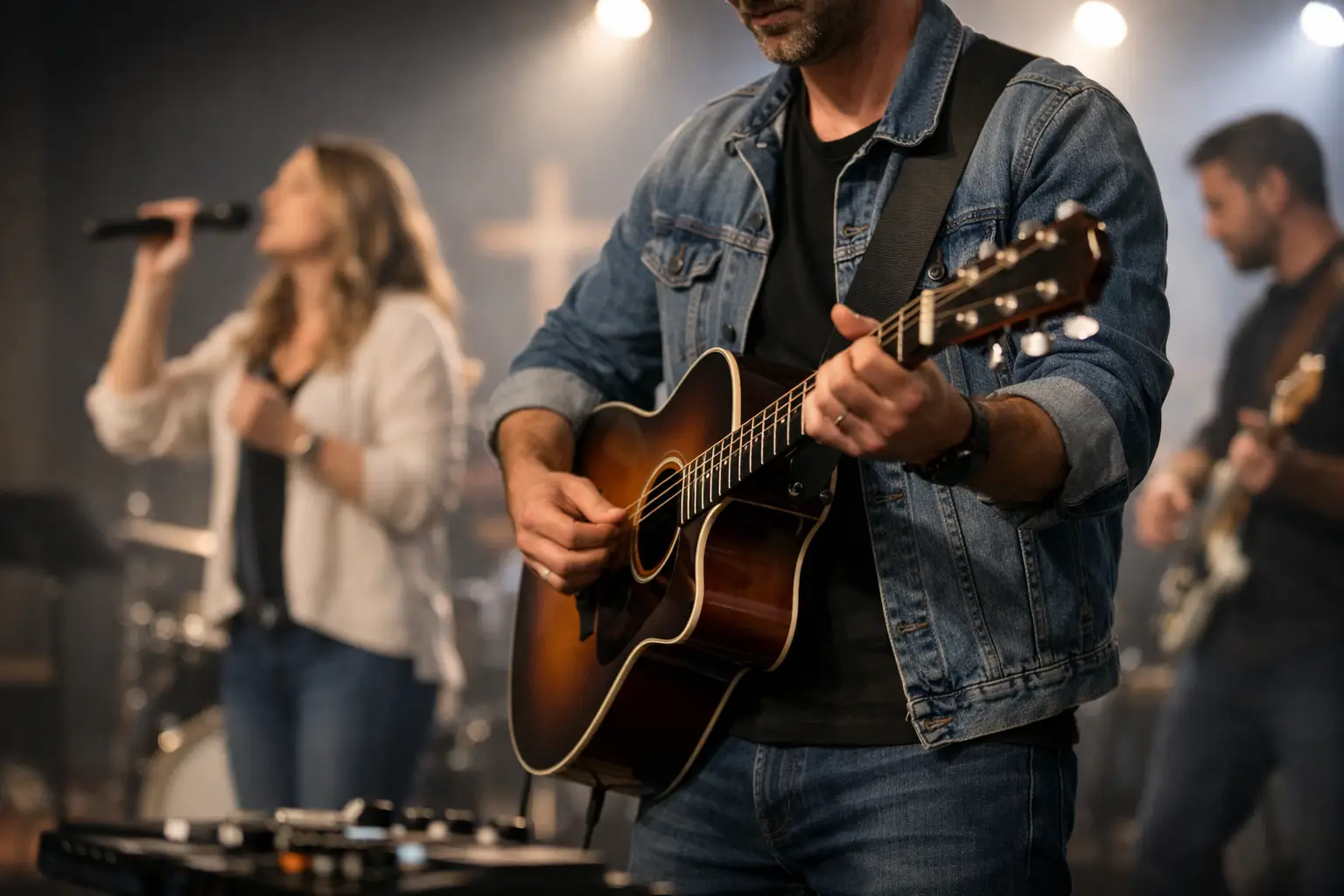
The moment a worship leader holds a chorus for an extra pass, your guitar part has to do more than supply the right chord. It has to leave room for the vocal, connect with the band, and help the room keep singing. That is where practical church band guitar tips matter most. Great church guitar is not about filling every open space. It is about knowing what the song, the leader, and the congregation need from you right now.
A player can know plenty of chords and still feel unsure in a service. The missing piece is usually not more speed or more gear. It is learning how to choose voicings, rhythm, and musical space with purpose. Build those habits, and you will become the guitarist people trust in rehearsal and on Sunday morning.
Church Band Guitar Tips Start With Your Role
In a church band, your role changes from song to song. A modern worship arrangement with acoustic guitar, keys, bass, drums, and electric guitar does not need five musicians playing full open-position chords in the same register. That creates a crowded sound, even when everyone is technically correct.
Listen for the center of the arrangement. If the acoustic guitar is strumming broad chords, the electric guitar can use smaller triads, light swells, or a simple rhythmic hook higher on the neck. If the keyboard player is carrying a full pad, you may need to play less often, not louder. When the band drops down for a prayerful verse, a clean, well-timed chord may serve better than a busy pattern.
This does not mean you should disappear. It means your contribution should be intentional. Think like a supporting vocalist: know when to blend, when to answer, and when to stay quiet. A tasteful guitar part makes the entire team sound more confident.
Build a Small Set of Useful Voicings
Open chords are a solid foundation, especially for leading songs at a beginner-friendly level. But church music often benefits from voicings that sound fuller without becoming heavy. Start by learning movable major and minor triads on the top three strings. These shapes give you a clean voice that can sit above keyboards and acoustic guitar without competing for the same frequencies.
Then add color gradually. Major 7, dominant 7, minor 7, add9, and suspended chords are some of the most useful sounds in gospel and worship settings. You do not need to grab every note of a large chord shape. In a full band, the bass player may already provide the root, while keys may cover the lower harmony. Your job can be as simple as playing the third, seventh, and a tasteful color tone.
For example, in the key of G, instead of always playing a full G chord, try a smaller G major triad near the 7th fret. When the progression moves to C, find the closest C triad rather than jumping back to an open shape. That smooth movement creates a polished sound and makes common progressions feel connected.
Practice voicings in one key first, then move them through all 12 keys. Many church songs are played in guitar-friendly keys such as G, D, A, E, and C, but worship leaders often choose keys for the vocal range of the congregation or lead singer. A capo can help, but it should not be the only answer. Learning the Nashville number system helps you recognize that a 1-5-6-4 progression works the same way in G, A, C, or E.
Let Chord Changes Move, Not Jump
Good voice leading is one of the fastest ways to sound more musical. When one chord changes to another, look for notes that can stay the same or move by only one or two frets. This is especially effective on slow worship songs, where every transition is easy to hear.
Instead of treating each chord as a separate shape, see the progression as a line. On a 1-4-5 progression, find three-note shapes that stay in the same area of the neck. Your hands will move less, and the harmony will sound smoother. This is a useful discipline for beginners and experienced players alike.
Lock Into the Groove Before Adding Fills
The quickest way to make a strong chord progression feel weak is to play a rhythm that ignores the drummer. Before adding fills, listen closely to the hi-hat, snare, kick, and bass. Your strumming or picking pattern should reinforce the pulse, not float over it.
In a straight contemporary worship song, that may mean steady eighth notes with a few muted strums for movement. In a gospel-influenced groove, you may need more syncopation, shorter chord stabs, and a stronger awareness of the backbeat. The exact part depends on the song, but the principle stays the same: rhythm comes before decoration.
Practice with a metronome on beats 2 and 4. This trains you to feel the backbeat instead of relying on a click that marks every beat. You can also play along with a drum loop and limit yourself to one chord shape for several minutes. If your rhythm feels good on one chord, it will carry over when the progression gets more complex.
Fills should come from the song’s melody, chord tones, or the space between vocal phrases. Do not place a fill where the worship leader is giving an instruction or singing a key lyric. A short answer after a vocal line can add energy. A long run over the next lyric can distract from it.
Learn to Hear the Service, Not Just the Song
A church service rarely follows an arrangement exactly as recorded. The leader may repeat a bridge, return to the chorus, change dynamics, or move into spontaneous prayer. Your preparation should include the song map, but your ears must remain open after the first downbeat.
Watch the worship leader for cues. Learn the signals your team uses for repeat, stop, build, drop, and move to the next section. If there are no established signals, ask during rehearsal. That small conversation can prevent confusion during a live moment.
Also listen for harmonic cues. A leader may begin singing a new line over a sustained chord, and the keyboard player may suggest the next movement before anyone says it out loud. If you understand common gospel progressions, turnarounds, and number movement, you can follow with more confidence. You do not need to predict every choice. You need to stay calm, listen well, and choose a simple part when you are uncertain.
Prepare for Rehearsal Like a Reliable Musician
Rehearsal is not the place to first discover the key, form, or difficult transition. Come in knowing the original recording well enough to recognize the intro, verse, chorus, bridge, tag, and ending. If a chart is available, mark the spots where the arrangement changes or where your guitar has a featured role.
A helpful pre-rehearsal routine has four parts:
- Identify the key and write the progression in numbers.
- Choose two or three voicing areas on the neck for each song.
- Practice the main rhythm at the recorded tempo and at a slower tempo.
- Plan one or two fills, then be ready to leave them out if the arrangement is already full.
Bring a tuner, spare cable, picks, and a working power supply if you use pedals. These details may seem basic, but they communicate care for the team. Reliability is part of musicianship.
During rehearsal, avoid turning every run-through into a personal practice session. If you miss a chord, recover quickly and keep listening. Ask focused questions between songs, such as whether the bridge will build each time or whether the final chorus will repeat. Those answers are more valuable than adding another flashy lick.
Use Tone to Support the Room
A clean tone with enough clarity usually works better than a huge sound. Start with a volume level that blends, then let the sound engineer guide the balance. Too much low end can fight the bass guitar and keyboard left hand, while too much delay can blur a fast progression.
For rhythmic parts, use a clear tone with controlled sustain. For ambient moments, add reverb or delay carefully, making sure the repeats stay in time with the song. Overdrive can add lift in a bigger chorus, but use less gain than you might use when practicing alone. What sounds exciting in isolation can become harsh when drums, keys, and vocals enter.
If you use effects, learn to make quick changes without staring at your pedalboard. But do not assume pedals are required to sound effective. Clean timing, strong voicings, and good dynamics will carry a simple setup a long way.
Practice the Skills That Show Up on Sunday
Set aside part of your practice time for church-specific situations. Play a 1-6-4-5 progression in several keys. Practice entering on beat 2, the and of 3, or after a full measure of rest. Work on holding a chord quietly while listening for a cue to build. These are the skills that turn theory into usable worship-band musicianship.
Record yourself playing with a backing track and listen back honestly. Is your rhythm steady? Are your chord changes clean? Do your fills leave room for the melody? Recording reveals habits that are easy to miss while you are focused on your hands.
Most of all, let preparation give you freedom. When your chords, groove, and song form are secure, you can spend less energy worrying about the next change and more energy serving the moment. Play with humility, listen with care, and aim to make everyone around you sound better. That is the kind of guitar playing a church band will always welcome.
Leave a Reply