
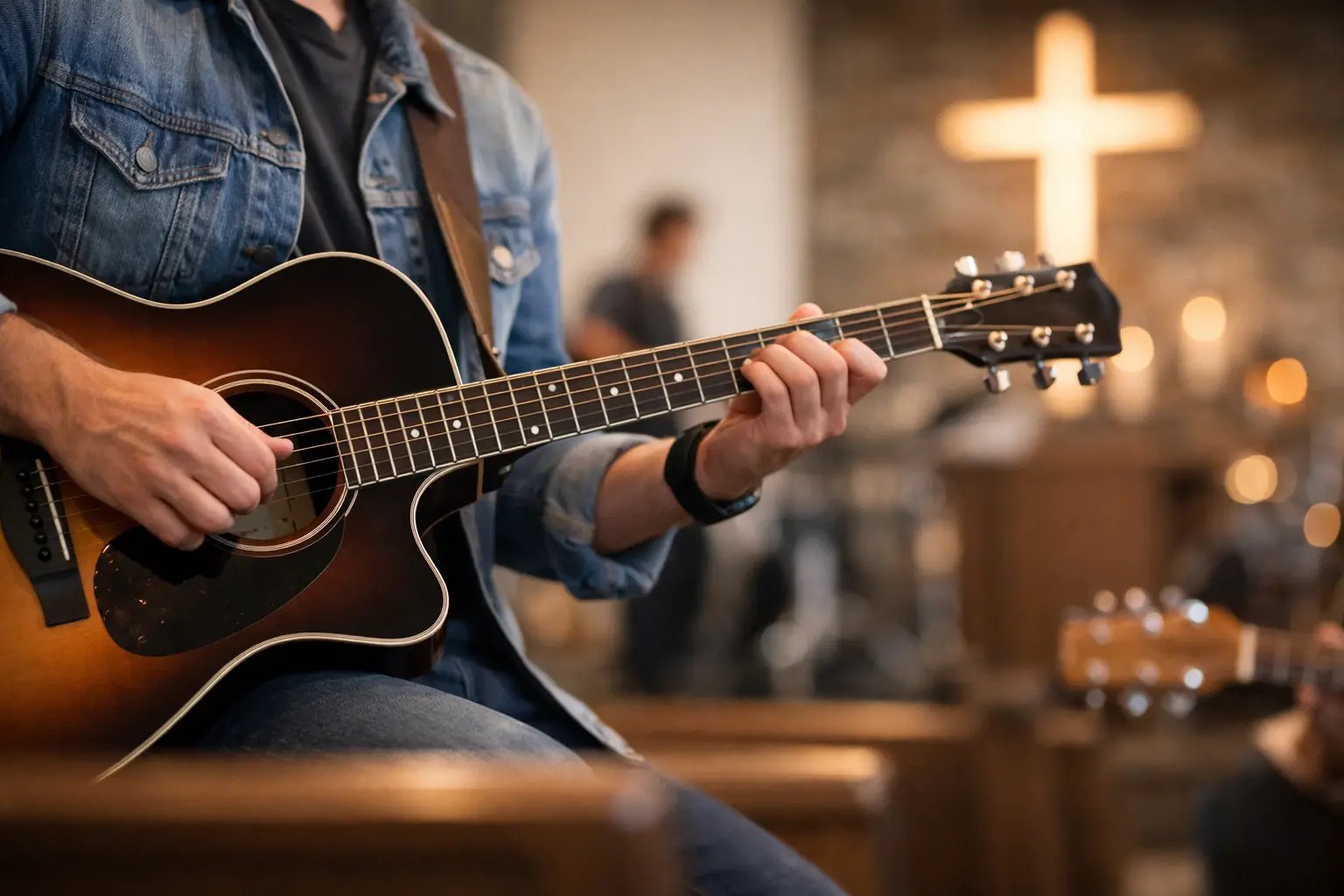
A worship leader calls a song in A, then moves into a spontaneous vamp in D. The keyboard player is filling the middle, the bassist is holding the foundation, and you need a useful chord sound without stopping to search for a shape. That is where the gospel guitar caged system becomes practical. It gives you a map of the fretboard so you can find chords, inversions, and melodic ideas in more than one place.
CAGED will not automatically make a guitarist sound gospel. Gospel guitar depends on rhythm, voicing choices, listening, and knowing when to leave room. But CAGED can organize the fretboard knowledge that makes those skills easier to apply under real service conditions.
What CAGED Really Gives a Gospel Guitarist
The name CAGED comes from the five familiar open-chord forms: C, A, G, E, and D. As you move these forms up the neck and use a barre or partial barre where needed, they reveal connected major-chord shapes. A single major chord can be found in five overlapping areas of the neck.
For a church guitarist, the goal is not to play every full six-string shape. Full shapes often sound too thick beside keys, organ, vocals, and another guitar. The value is seeing where the chord tones live: the root, third, and fifth. Once you can see those tones, you can choose smaller voicings, add color notes, and connect chords without making large jumps.
Take the key of G. You may know a G chord near the nut, an E-form G barre chord at the third fret, or a D-form G higher on the neck. CAGED helps you recognize that these are not separate facts to memorize. They are connected versions of the same harmony. That connection becomes especially valuable when a worship song changes key or when the band leader wants a brighter, higher-register sound.
Think in chord tones, not just shapes
A shape is useful, but it is only the beginning. Gospel harmony often asks you to turn a plain major chord into Gadd9, G6, Gmaj7, or Gmaj9. If you only know a grip by its visual pattern, these changes can feel random. If you know where the root, third, fifth, seventh, and ninth are around the shape, you can make musical decisions quickly.
For example, in a G major area, B is the third, D is the fifth, F# is the major seventh, and A is the ninth. You do not need all of those notes at once. In a full band, two or three well-chosen notes can sound more polished than a large chord with every string ringing.
How the Gospel Guitar CAGED System Fits Real Chord Progressions
The best way to learn CAGED is through progressions you will actually hear at rehearsal. Start with a simple I-IV-V in one key. In G, that is G-C-D. Instead of finding each chord anywhere on the neck, choose one fretboard area and locate nearby forms of all three chords.
Suppose you are working around the seventh to tenth frets. Find a G voicing there, then identify nearby C and D options. Play the progression slowly while keeping your hand in that neighborhood. Your first attempts may sound less familiar than open chords, but this is how you build the ability to comp smoothly behind a singer.
Next, apply the same approach to a common gospel movement: I-vi-ii-V. In G, that becomes G-Em-Am-D. This progression is a strong training ground because it teaches you to see major and minor sounds in one position. Start with compact triads on the top three or four strings. Then add a seventh or ninth only after the basic movement feels comfortable.
The important question is not, “What is the biggest chord I can play?” Ask, “What register is open, and what will help the song move?” If the keyboardist is playing dense left-hand harmony, a higher triad or a two-note shell may serve better. If you are the only harmonic instrument, you may choose a fuller voicing. CAGED gives you options. Your ears decide which option belongs in the moment.
Use nearby inversions for smoother movement
Inversions are where CAGED starts to sound less like an exercise and more like music. An inversion simply puts a note other than the root on top or in the bass. On guitar, the most useful application is often the top note. A changing top note can create a melodic line while the harmony moves underneath.
Practice G, C, and D triads on strings 1, 2, and 3. Then practice the same chords on strings 2, 3, and 4. Notice which inversion puts the notes closest together. Those close movements are useful for worship vamps, slow songs, and transition moments when you want support without crowding the arrangement.
You can also connect a chord to the next one with a half-step approach. If you are moving into C, try approaching one of its chord tones from one fret below. Use this lightly. A passing note should lead somewhere, not become a distraction from the lyric or the groove.
Build Color Without Losing the Chord
Rich gospel chords are not random stacks of notes. They work because the basic harmony remains clear. CAGED helps you locate a stable major or minor framework, then add color with purpose.
Start by learning these additions around each major-chord area: add9, 6, maj7, and maj9. Around minor chords, learn minor 7, minor 9, and minor 11. You do not need to memorize a separate dictionary of hundreds of grips. Begin with one shape family in one key, listen carefully, and move it through the keys you use most often.
A practical rule for live playing is to protect the third when the chord quality needs to be clear. The third tells the listener whether the chord is major or minor. The fifth is often the first note you can omit, especially when the bass player already defines the root. This is why small three- and four-note voicings are so effective in church bands.
Be careful with major sevenths and ninths during simple congregational songs. They can sound beautiful, but they can also change the emotional feel of a familiar chord if used constantly. Let the lyric, the leader, and the rest of the band guide your choices. Taste is part of musicianship.
A Practice Plan That Transfers to Sunday
Set aside 20 focused minutes rather than trying to memorize the entire neck in one sitting. Start by naming the roots of one CAGED form. Then build major triads around that form and play a familiar I-IV-V progression without leaving the area.
After that, play the same progression with a steady rhythm. Do not practice voicings as isolated blocks only. In a service, timing matters as much as chord knowledge. Use a simple quarter-note pulse first, then try short chord stabs, anticipated entrances, and spaces between phrases.
Finish by transposing the progression to a second key. Keys such as G, C, D, E, A, F, and Bb are worth regular attention because they appear often in worship and gospel settings. If a key feels uncomfortable, do not avoid it. Find one useful position and make that position dependable before adding more.
Here is a simple weekly rotation:
- Day one: major CAGED areas and I-IV-V in two keys.
- Day two: minor shapes and I-vi-ii-V connections.
- Day three: top-string triads and inversions.
- Day four: add9, 6, seventh, and ninth colors.
- Day five: play along with a worship song and choose parts that leave room.
Record a short practice session occasionally. Listen for clean chord changes, consistent time, and whether your voicings sit in a useful register. The goal is not to sound busy. The goal is to be ready.
Common CAGED Mistakes in Church Guitar
The first mistake is treating CAGED as a collection of barre chords. Barre chords are part of the system, but they are not the destination. If every chord uses all six strings, your sound may become heavy and tiring in an ensemble.
The second mistake is learning shapes without learning note names. You do not have to become a theory specialist overnight, but you should know where the roots are. Knowing the root lets you transpose quickly, communicate with the band, and recover when the service moves in an unexpected direction.
The third mistake is practicing only in silence. Gospel guitar is rhythmic. Put your CAGED shapes into a groove, count the form, and practice entering on the right beat. A great voicing played late will not help the band.
Finally, do not force a shape just because you learned it. Sometimes the best guitar part is a simple triad. Sometimes it is one sustained note. Sometimes it is silence while the vocalist speaks or the keyboard carries the transition. Strong players use the fretboard map to make better musical choices, not to fill every open space.
As your CAGED knowledge grows, bring it into rehearsals one small piece at a time. Learn one new position, use it in a familiar progression, and listen to how it supports the room. With steady practice, the neck stops feeling like a row of disconnected shapes and starts feeling like a place where you can serve the song with confidence.
Leave a Reply