
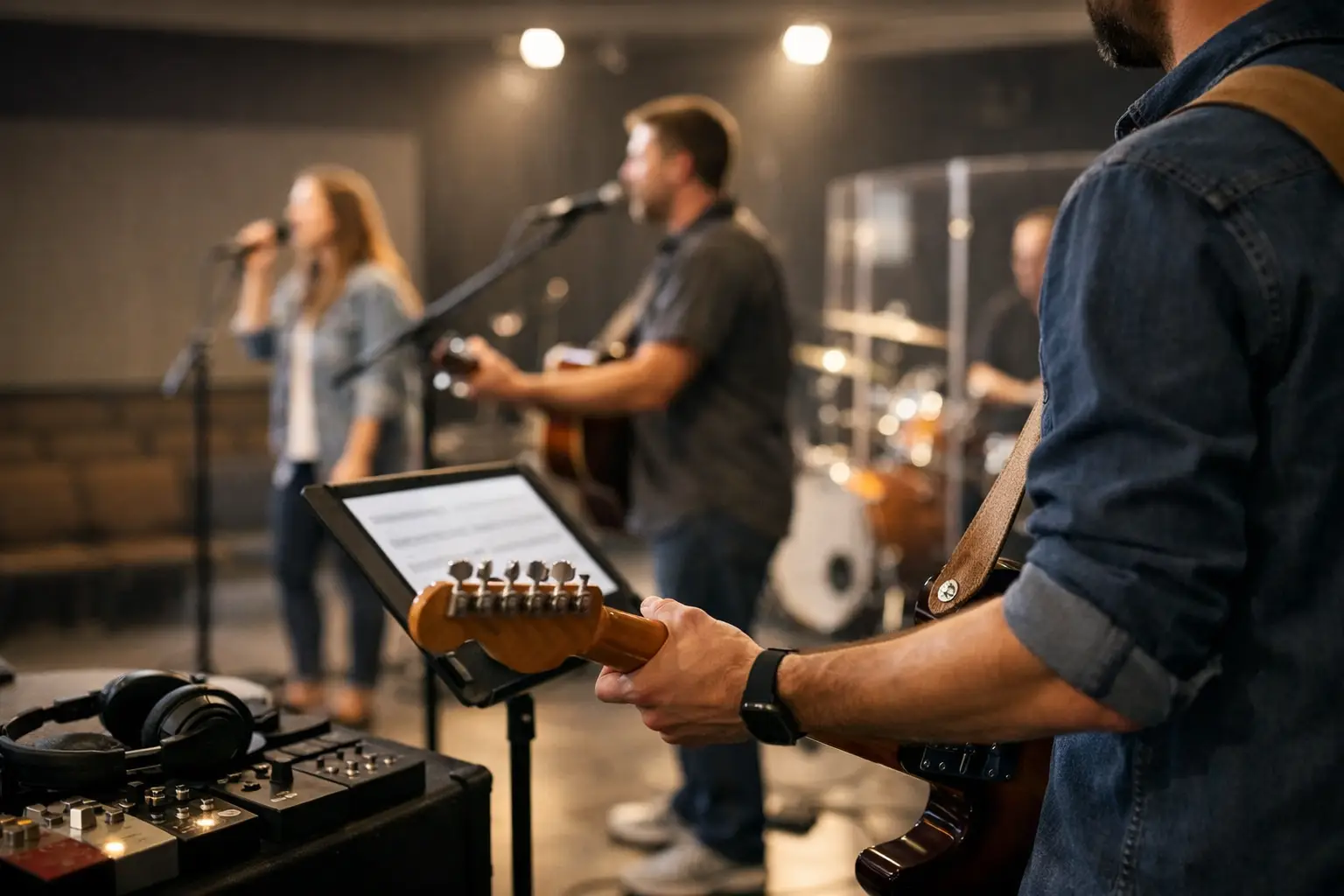
A good rehearsal can make Sunday feel peaceful before the first note is played. This church guitar rehearsal guide is built for the guitarist who wants to arrive prepared, hear the band clearly, and serve each song with confidence instead of scrambling to find chords or guess the next cue.
Church guitar is not only about knowing the song. It is about knowing your role in the song. You may need to support a singer during a quiet verse, lock in with drums on a vamp, leave room for keys, or follow a worship leader who extends a chorus without warning. Rehearsal is where those decisions become familiar enough to feel natural in the service.
Start Your Church Guitar Rehearsal Before You Arrive
The most useful rehearsal work happens before the band gathers. If you receive a set list, listen through every song at least once. Do not just listen for chord changes. Listen for the structure: where the intro begins, when the full band enters, whether the bridge repeats, and how the song ends.
Write a simple chart in a format you can read quickly. Include the original key, the section order, and any important repeats or stops. If the worship leader commonly changes keys, write the Roman numerals alongside the chord names. A progression such as I-vi-IV-V is easier to move than a page of chord names when the song is called in a new key.
For gospel and contemporary worship settings, identify the movement that gives the song its character. That might be a familiar 1-6-2-5 turnaround, a passing diminished chord, a walk-up to the IV chord, or a rhythmic figure the whole band plays together. You do not need to fill every measure with extra harmony. You do need to recognize the moments where your part helps the band sound connected.
Spend a few minutes warming up in the keys on the set list. Practice your major and minor triads on the top four strings, then review a few movable seventh-chord shapes. If the songs are in E, A, C, and G, do not spend your whole practice session in one comfortable key. Church musicians are often asked to move quickly, and confidence grows when your hands know the neck beyond one favorite position.
Build a Part That Fits the Band
A guitar part should help the song breathe. Before choosing a voicing or rhythm, listen to what the other instruments are already covering. If the keyboard player is using wide, full chords and the acoustic guitar is strumming steady eighth notes, a thick barre chord on every beat may make the mix feel crowded.
Try playing smaller voicings higher on the neck. Triads, partial chords, and two-note shapes can add color without competing for the same space. For example, when the keys are carrying the root and low harmony, you can play the third and seventh of a dominant chord or a simple triad that outlines the movement. This approach sounds intentional, especially in a gospel band where harmony is rich and several instruments may be active at once.
Your rhythm choice matters just as much as your chord choice. A slow worship ballad may need sustained chords with gentle swells. A praise song may need a muted sixteenth-note groove or a bright, syncopated pattern that works with the hi-hat. Start with the simplest rhythm that supports the feel. Add detail only after you know what the drummer, bassist, and keyboard player are doing.
There is a trade-off here. Playing less can feel exposed if you are used to strumming constantly, but space is often what makes a band sound professional. On the other hand, playing too little can leave an energetic song flat when the arrangement needs guitar-driven momentum. Let the song, the leader, and the band arrangement tell you which choice to make.
Know Your Tone Before the Downbeat
Do not spend the first ten minutes of rehearsal building a sound from scratch. Arrive with a reliable clean tone, a drive sound for bigger sections, and a lead or ambient option if the music calls for it. Set your volume so you can move between sounds without creating a sudden jump that surprises the sound team.
Keep effects supportive. Delay and reverb can create a beautiful worship texture, but too much can blur rhythmic parts and hide chord changes. If you are unsure, use less effect at rehearsal and add a little only after you hear the full band.
Use Rehearsal to Learn Cues, Not Just Songs
The biggest difference between practicing alone and rehearsing with a worship team is communication. Pay attention when the leader gives verbal cues, but also watch for visual cues such as a raised hand, a guitar neck lifted toward the band, or a step toward the microphone. Ask how the team signals a repeat, a transition, a key change, or an ending.
Write those notes directly on your chart. A note such as “repeat chorus twice, then down” is more useful than hoping you remember the conversation on Sunday. If a leader says, “We may stay on the bridge,” mark the likely vamp progression and practice it until you can loop it without staring at your hands.
This is especially helpful in gospel worship, where a song may shift from its recorded arrangement into a spontaneous exhortation, prayer moment, or extended tag. Learn the core progression well enough that you can keep playing when the printed form ends. Usually, a steady groove and clean chord movement will serve the moment better than a complicated lick.
When you do not know what is coming, simplify. Find the tonal center, listen for the bass movement, and use familiar voicings. If the band is holding on the IV chord, you do not have to prove you know every passing chord available. Stay with the team until the direction is clear.
Ask the Questions That Prevent Problems
Rehearsal is the right place to clarify details, but timing matters. Listen through the instruction first, then ask short, specific questions when there is a pause. “Are we taking the bridge up a half step?” or “Do you want guitar to play the intro figure with keys?” helps everyone move forward.
Avoid asking questions that can be answered by listening one more time. You will grow faster by developing your ears and observing how experienced players handle the arrangement. Still, never pretend you understand a cue when you do not. A respectful question now is better than a confused entrance during the service.
If you are new to the team, ask where the guitar should sit in the mix and whether there are particular songs where the leader wants a signature part. Some teams want the guitar to follow recordings closely. Others prefer players to create a supportive live arrangement. Neither approach is automatically better. The right answer depends on the team’s sound, available instruments, and the leader’s vision.
Practice the Transitions That Can Derail a Service
Most mistakes do not happen in the middle of a familiar chorus. They happen at transitions: the pickup into a new section, the stop before the final chorus, the modulation, or the ending that changes after the leader speaks.
During rehearsal, make a mental note of the two or three places where you felt uncertain. Afterward, practice only those spots. Play the last measure of one section into the first measure of the next. Repeat it slowly, then bring it up to tempo. This focused work is more effective than restarting the entire song every time.
Also practice getting into the key without a count-in. Have someone name the key, find the I chord, and play a simple I-IV-vi-V progression immediately. This small habit builds the kind of practical musicianship that helps when a worship leader says, “Let’s take that in B.”
Bring a Serving Mindset to the Room
Preparation is a way of caring for the team and the congregation. Arriving on time, having your gear ready, knowing the songs, and listening closely tells others they can depend on you. That reliability matters as much as flashy fills or advanced chord vocabulary.
Be ready to adjust. Some rehearsals will be detailed and organized. Others will be short, with little time to work through arrangements. In either case, stay calm, take clear notes, and focus on the next useful decision. A guitarist who can hold down the harmony, follow the flow, and make the band sound better is a valuable musician in any church setting.
Each rehearsal is also a classroom. Notice which voicings blend well, where your rhythm locks with the drums, and when silence creates more impact than another chord. Keep building those observations into your practice, and your guitar will become a steady, confident voice in the worship team.
Leave a Reply