
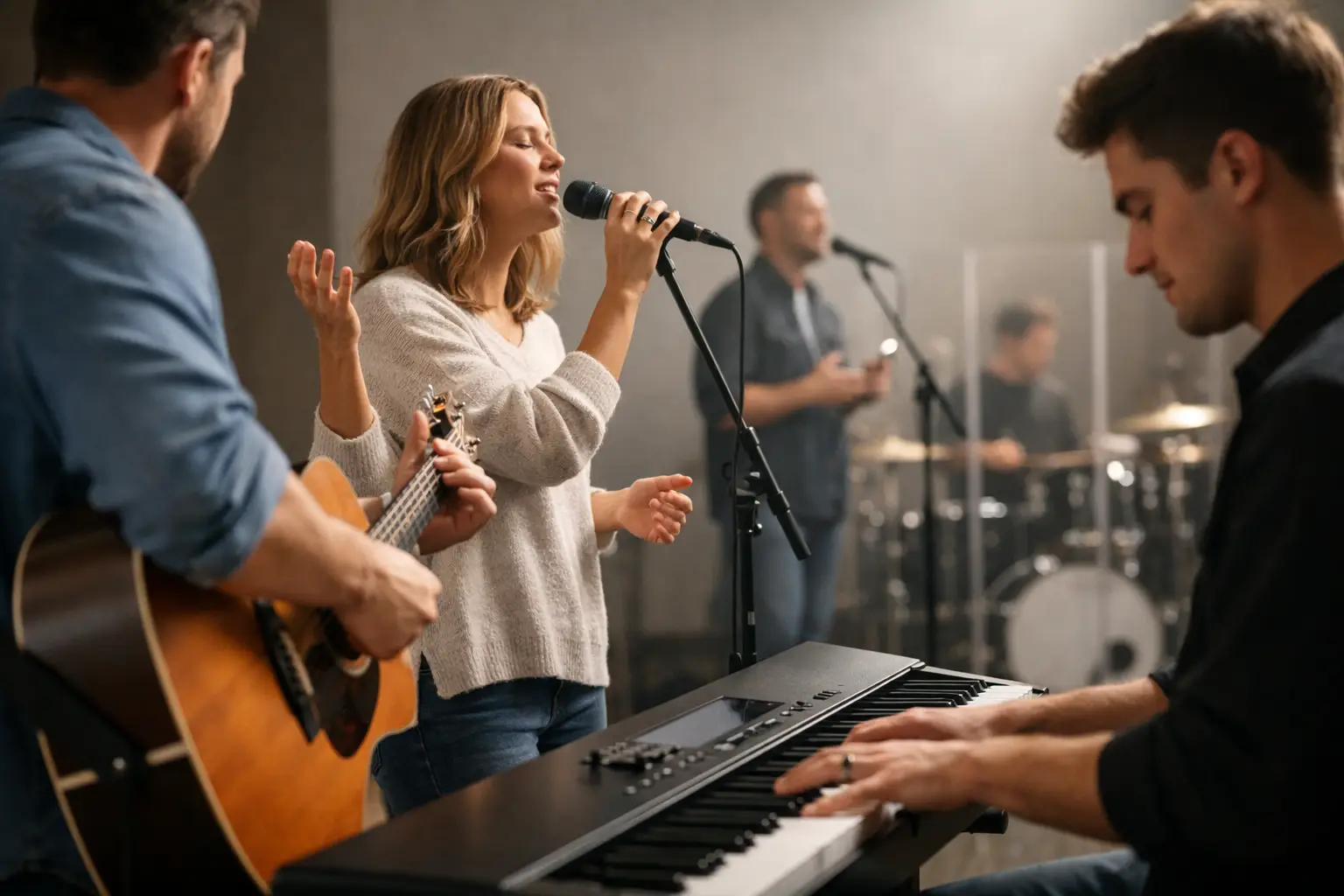
A guitarist can know plenty of chords and still feel unprepared when the worship leader changes the order, the singer holds a spontaneous vamp, or the keyboard player fills every available space. Church musicianship is the skill of making musical choices that support the song, the team, and the moment. It is what turns guitar knowledge into dependable service-ready playing.
For gospel and worship guitarists, that means more than learning a few familiar progressions. You need to hear movement, recognize what the band needs, play in keys that fit real singers, and know when your best contribution is a rich chord, a steady rhythm part, a short melodic answer, or complete silence.
What Church Musicianship Looks Like on Guitar
Strong church musicianship starts with a simple shift in purpose: you are not trying to fill every measure. You are helping the congregation sing, helping the worship leader communicate, and helping the band sound unified. Your guitar part should add clarity, movement, warmth, or energy without competing with the vocal message.
That changes how you approach chords. A basic open-position G chord may work in a small acoustic setting, but a full six-string grip can become muddy beside piano, organ, bass, drums, and multiple singers. In a full band, a smaller voicing on the top four strings may create more space while still clearly defining the harmony. The chord is not wrong. The setting determines whether it is useful.
It also changes how you listen. Instead of asking, “What can I play here?” ask, “What is missing?” If the drummer is creating energy and the keyboard is holding wide pads, you may only need a light rhythmic pulse. If the arrangement thins out before a chorus, a well-placed swell or simple triad can help lift the section without forcing the moment.
This is why church-ready guitar playing is less about having one signature sound and more about having options. Build chords, rhythm, and confidence so you can choose the right role quickly.
Build the Harmonic Vocabulary Gospel Music Requires
Gospel harmony often moves with more color than a simple four-chord worship progression. You will hear major seventh chords, dominant chords, minor sevenths, diminished passing chords, suspended sounds, slash chords, and turnarounds that lead the band back to the top. None of this has to feel mysterious when you learn it in usable groups.
Start by knowing the number system in every key. If a leader says, “Let’s take it from the four,” you should be able to find that chord whether the song is in G, A-flat, C, or E. Nashville numbers are especially helpful because church services regularly change keys to support different vocal ranges.
From there, learn common movements rather than isolated chord shapes. Practice a 1-6-2-5 progression in several keys. Then add color: try major seventh voicings on the 1 and 4, a minor seventh on the 6 and 2, and a dominant seventh on the 5. Hear how each chord points toward the next one.
A useful next step is the gospel walk-up or turnaround. In the key of C, you might move from C to A7 to Dm7 to G7, returning to C. Once that sound is familiar, take the same function into F, B-flat, E-flat, and other common church keys. The goal is not to memorize a long list of tricks. The goal is to recognize a musical sentence and speak it naturally.
Choose Voicings That Leave Room
Voicing selection is one of the clearest signs of mature ensemble playing. If a keyboard player is covering low roots and dense harmony, avoid doubling the same low register. Move higher on the neck and use three- or four-note shapes built around the third, seventh, and color tones. These notes often communicate the chord quality more clearly than a large root-heavy grip.
For example, when the bass player establishes the root of a Dm7 chord, your guitar can focus on F, C, and E if the arrangement supports that color. You do not need to play every note of the chord every time. In fact, leaving out the root often makes your part sound cleaner.
There is a trade-off. In a rehearsal with no keyboard or bass, stripped-down voicings may sound incomplete. Learn both approaches: fuller shapes for leading or small groups, and compact voicings for a crowded band mix.
Rhythm Is Your Most Reliable Contribution
A church guitarist with steady time is more valuable than a guitarist with advanced chords who cannot settle into the groove. Rhythm gives a worship set shape. It helps a congregation feel where the pulse is, supports transitions between sections, and keeps the band connected when the arrangement changes.
Do not treat strumming as an afterthought. Practice playing the same progression with different feels: straight eighth notes, a relaxed 6/8 pulse, a driving 16th-note pattern, and a sparse ballad texture. Use a metronome, drum loop, or recorded track, but make sure you can feel the subdivision rather than simply chase the beat.
In gospel settings, guitar rhythm often works best when it is intentional and selective. A short chord stab on beats two and four can support a choir-driven groove. Muted scratches can add motion beneath a vamp. Arpeggiated triads can create lift during a quiet prayer moment. The part should match the emotional direction of the song, not just the chord chart.
Pay attention to articulation as well. A chord that rings for four beats says something different from a clipped chord played on the offbeat. When the band needs space, release your fretting hand early. When the chorus needs width, let the higher strings ring. These details make simple parts sound confident.
Learn to Follow the Service, Not Just the Chart
A chart is a map, but a live worship service is not always a fixed route. Leaders may repeat a chorus, move into an open vamp, call for a key change, return to an earlier lyric, or speak over soft music. Your preparation should give you enough security to follow those moments without panic.
Before rehearsal, listen for the form of each song. Identify the intro, verse, chorus, bridge, turnaround, ending, and likely vamp section. Write numbers above chords when possible. If the key changes, write the new number relationship rather than relying only on letter names.
During rehearsal, watch for cues. Some leaders signal with a hand, a head nod, a lyric change, or a spoken phrase. Others communicate through their musical choices, such as holding the five chord longer before returning home. Learn the habits of your specific team, and do not be embarrassed to ask what cues they prefer.
When you lose your place, do not stop the groove by searching visibly for the perfect chord. First, listen for the bass movement and the vocal melody. A simple, quiet chord on the next strong beat is usually better than a rushed, complicated recovery. Reliability builds trust.
A Practical Church Musicianship Practice Plan
Practice becomes more effective when it resembles the situations you actually face. Rather than spending every session on scale patterns or random chord changes, dedicate time to four connected areas:
- Play one common gospel progression in at least three keys, using both full and compact voicings.
- Keep a rhythm part going for two minutes without speeding up, then repeat it with a different feel.
- Listen to a worship or gospel recording and identify the form, key, chord movement, and moments where the guitar enters or lays out.
- Practice following a simple vocal melody by answering it with short phrases, then leave two beats of silence after each answer.
Even 20 focused minutes can produce real progress. The key is repetition with purpose. If Sunday services regularly use E-flat, A-flat, B-flat, and C, do not keep practicing only in G because it feels comfortable. Build familiarity where your team actually works.
Prepare Your Sound Without Chasing Gear
Your tone should support your part. A clean or lightly driven sound with enough clarity for extended chords will cover many church settings. Reverb and delay can add atmosphere, but too much effect can blur the rhythm, especially when the room is already live or the keyboard is creating pads.
Set a few dependable sounds before rehearsal: a clear rhythm tone, a warmer ambient tone, and a modest lead tone for brief fills. Then spend more time learning the songs than adjusting knobs. Great tone cannot compensate for weak timing, unfamiliar harmony, or poor listening.
The Humility Behind Great Church Musicianship
Serving well does not mean playing timidly. It means playing with purpose. There will be moments when the band needs you to establish the progression, lead an instrumental section, or add a strong rhythmic voice. Step forward when the music calls for it. Step back when the vocal, prayer, scripture, or another instrument needs the space.
That balance develops over time, especially when you record rehearsals and listen back honestly. Notice whether your guitar part strengthened the groove, clarified the chords, and supported the dynamic shape of the song. Small adjustments in volume, register, and rhythm can make a major difference.
Keep growing into the player your team can count on: prepared in the key, steady in time, aware of the room, and ready to serve the song. That kind of guitar playing may not always draw attention to itself, but it helps create the confidence and freedom a worship team needs to lead well.
Leave a Reply