
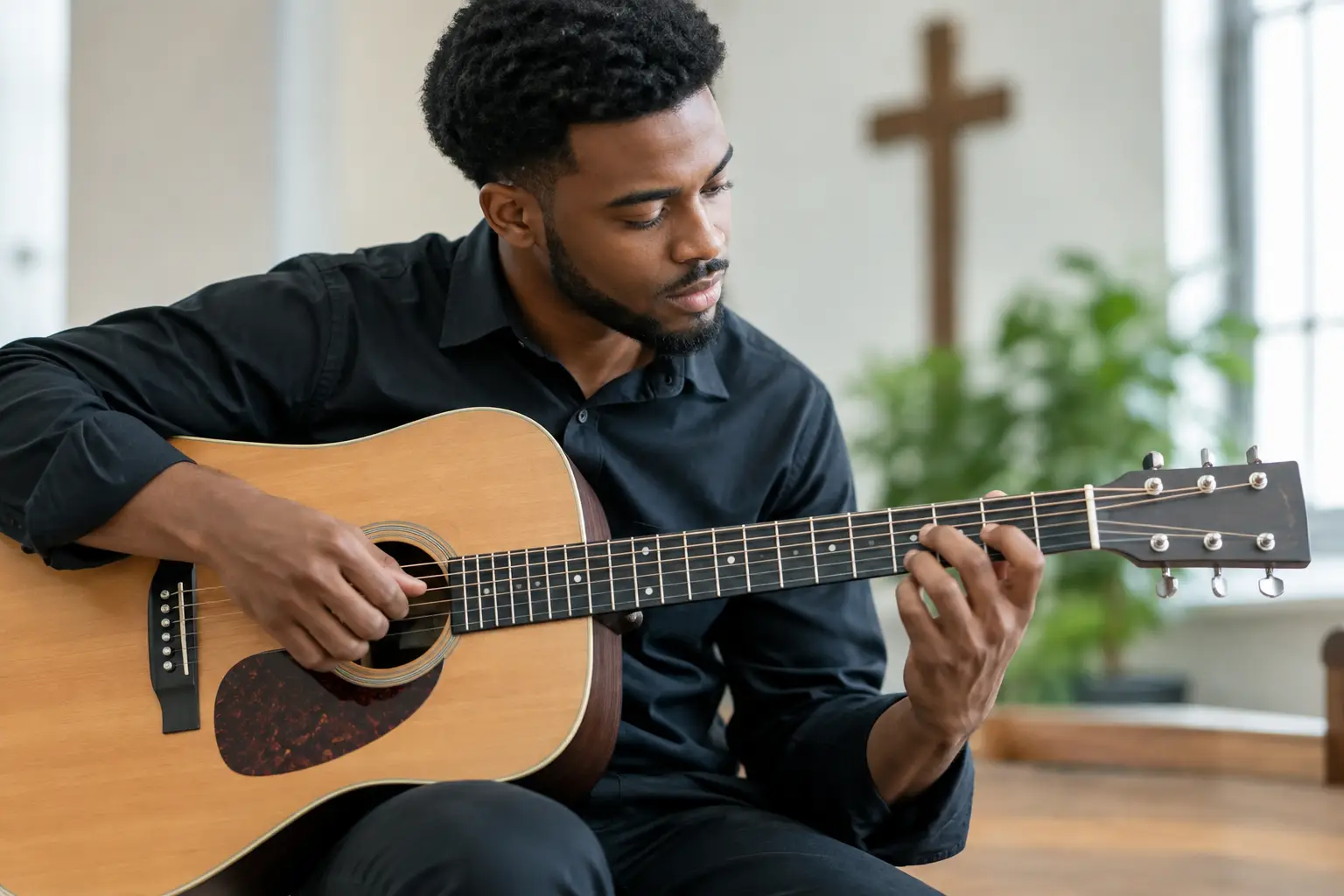
A worship leader calls a song you have heard only once. The keyboard player begins a familiar movement, the bass player points toward the next chord, and the band is already moving. In that moment, gospel guitar ear training is not an abstract theory exercise. It is the skill that helps you listen, locate the harmony, choose a useful voicing, and serve the song without panic.
Reading charts and learning theory matter. But church services do not always follow a fixed arrangement. A leader may repeat a chorus, change the key, add a vamp, or move into spontaneous worship. Your ear gives you a way to stay connected when the written plan changes.
The good news is that this skill is trainable. You do not need perfect pitch, and you do not need to identify every chord by a complicated name on the first listen. Start by hearing function, direction, and familiar gospel sounds. Then connect what you hear to shapes you can play on the guitar.
What Gospel Guitar Ear Training Should Help You Do
Ear training for a church guitarist should lead to better decisions in a band, not just better quiz scores. You want to recognize where the music feels like home, hear when it is moving away, and predict the kind of resolution that may be coming.
For most gospel and worship settings, the first goal is hearing the key center, or the 1 chord. If the song is in G, G is home. Once you can hear that resting place, other chords become easier to understand by their relationship to it: the 4 creates lift, the 5 creates tension that wants to return, and the 6 minor often brings warmth or emotion.
You also need to hear common movement. A simple 1-4-5 progression is useful, but gospel music often adds color through 2-5 movement, walk-down bass lines, passing diminished chords, dominant chords, and turnarounds. You do not have to name every detail immediately. First, learn to hear the motion: Is the harmony rising? Is it pulling toward home? Is the band sitting on a vamp? Is the bass signaling a turnaround?
This approach is especially helpful when you play with stronger keyboard players. They may use rich extensions and altered chords that are difficult to identify note for note. Your job is often to hear the chord function and play a supportive shell, triad, or partial voicing that fits the sound.
Start With the Bass, Not the Biggest Chord
When a full gospel band plays, the keyboard may contain many notes at once. The bass usually gives you the clearest clue about the harmonic foundation. Train yourself to listen for the bass note before reaching for a chord shape.
Put on a recording of a gospel song or worship song with a clear rhythm section. Listen through one verse or chorus without playing. Hum the lowest note each time the harmony changes. Do not worry about whether you know the note name yet. Your first assignment is simply to notice when the bass moves and whether it goes up, down, or stays in place.
Next, find those bass notes on your low E or A string. Keep it simple. If you can follow the roots, you can often survive a new song by playing clean, well-timed chord fragments instead of guessing at dense voicings.
There is a trade-off here. Bass notes do not always tell the complete story. Gospel arrangements may use slash chords, inversions, or passing bass movement while the harmony above stays the same. Still, the bass is the best starting point because it gives your ear an anchor. As you grow, you will learn when the bass is a true root and when it is part of a walk-up or walk-down.
A five-minute root-finding routine
Choose one song in a key you know. Listen to a short section, pause it, and find the home note on the guitar. Then play only single-note roots along with the next pass. After that, say the scale degrees out loud as you follow the movement: 1, 4, 5, 1 or 1, 6, 2, 5.
Saying the numbers matters. Gospel musicians regularly communicate in numbers because a number system works in every key. When your ear hears 2 going to 5, you can move that sound from C to E-flat or A without learning a completely separate progression.
Learn the Gospel Sounds You Will Hear Repeatedly
Your ear develops faster when it has a small library of familiar sounds. Rather than practicing random intervals for weeks, connect each sound to a progression that shows up in church music.
Start with the 1-4 movement. Play it in several keys and notice the lift from home to the 4. Then play 4-5-1 and listen to how the 5 creates expectation before the return. These are foundational sounds for worship songs, hymn reharmonizations, praise breaks, and gospel choruses.
After that, spend time with the 2-5-1. In C, that is D minor, G, and C. In a gospel setting, the chords may be extended, such as Dm9, G13, and Cmaj9, but the directional pull is still the same. Hear the 2 as preparation, the 5 as tension, and the 1 as release.
The 6 minor is another sound worth knowing. A 1-6-2-5 progression appears in many gospel turnarounds because it keeps the harmony moving while leading naturally back home. Play it slowly in C, then in G, D, F, and B-flat. Do not rush to cover all 12 keys in one session. A few keys played with clear listening will teach you more than a fast, forgettable trip through every key.
Also practice hearing a dominant chord that leads somewhere unexpected. A chord like A7 may pull to D minor, even in a song centered around C. That sound is common in gospel harmony. It may feel like a temporary shift, but it usually has a clear destination. Ask yourself where the tension wants to go.
Sing Before You Search on the Fretboard
Many guitarists try to solve every musical question with their hands. For ear training, your voice is often the faster connection. You do not have to be a polished singer. You only need to sing pitches accurately enough to test what you hear.
When you hear a progression, sing the root movement before picking up the guitar. If you hear 1-6-2-5, sing those scale degrees against a simple drone or keyboard chord. Then find them on one string. This separates hearing from familiar muscle memory and makes your fretboard knowledge more flexible.
Try singing the top note of a chord as well. Gospel guitar parts often work best when you can control a simple melodic line on the top string while the band fills in the harmony. If the vocal melody is moving upward, you may be able to choose an inversion that supports it instead of competing with it.
This is where ear training becomes ensemble awareness. You are not listening only for the chord you can play. You are listening for the singer, the bass, the keyboard, the drummer’s feel, and the open space in the arrangement.
Turn Every Practice Session Into Listening Practice
Set aside focused ear work, but do not isolate it from your normal guitar practice. Apply it to the progressions, songs, and voicings you already use.
A practical session can begin with five minutes of singing and finding scale degrees in one key. Spend the next ten minutes playing a common progression by number in three keys. Then use a recording for ten minutes: identify the key, follow the bass roots, and find one turnaround or vamp by ear. Finish by playing along with a restrained rhythm part.
Record yourself during the final step. When you listen back, ask whether your chord changes line up with the band and whether your rhythm supports the groove. A correct chord played late can hurt the flow more than a simpler chord played with confidence and good time.
As your ear improves, give yourself less help. First use the recording at full speed. Then try to identify a progression without your guitar in hand. Finally, play it in a new key. That last step reveals whether you truly heard the numbers or only memorized shapes.
Use Ear Training at Rehearsal and in the Service
Rehearsal is not the place to prove that you know every substitution. It is the place to listen for the band’s vocabulary. Notice how the worship leader ends songs, what the keyboard player uses for turnarounds, and whether the bassist signals modulations clearly. Those repeated habits become part of your working ear.
If you lose the progression during a service, do not fill the space with random chords. Listen for the bass, find the key center, and simplify. A small triad, a muted rhythm part, or even a pause may serve the moment better than a busy guess. Then re-enter when you hear the movement clearly.
At your next rehearsal, choose one goal: hear every bass-root change in a single song, identify one 2-5 movement, or sing the final turnaround before you play it. Small wins build the calm, prepared listening that helps a church guitarist support the room with confidence.
Leave a Reply